
Asiad 20: Vietnam's team kata gold and the gap behind the 5-0
Câu trả lời lõi Tại Asiad 20, đội kata đồng đội nữ Việt Nam gồm Nguyễn Thị Ngọc Trâm, Bùi Ngọc Nhi và Hoàng Thị Thu Uyên giành HCV với tỷ số 5-0 trước Iran. Bùi Ngọc Nhi thêm HCĐ kata cá nhân, Nguyễn Thị Diệu Ly HCĐ kumite dưới 68kg. Mức thưởng được nhắc khoảng 1,2 tỷ đồng; toàn bộ số liệu chờ xác minh độc lập. Dữ kiện chính - Ba tuyển thủ kata đồng đội nữ Việt Nam: Nguyễn Thị Ngọc Trâm, Bùi Ngọc Nhi, Hoàng Thị Thu Uyên. - Chung kết kata đồng đội nữ: Việt Nam thắng Iran 5-0, theo một bản tin đơn nguồn. - Bùi Ngọc Nhi thua 0-5 ở kata cá nhân trước đối thủ chủ nhà Nhật Bản, sau đó nhận HCĐ. - Nguyễn Thị Diệu Ly giành HCĐ hạng dưới 68kg kumite. - Mức thưởng được nhắc khoảng 1,2 tỷ đồng; chưa rõ theo cá nhân hay cả nhóm. Nguồn và thời điểm Nguồn: bản tin tổng hợp về Asiad 20 (nhà thi đấu Toyohashi, Nhật Bản), chưa xác minh độc lập và không có nguồn dẫn gốc; ngày công bố nguồn không xác định. Tham chiếu dữ liệu: VuaBong.vn. Hỏi đáp liên quan Hỏi: Việt Nam giành những huy chương nào ở môn karate tại Asiad 20? Đáp: Một HCV kata đồng đội nữ và hai HCĐ gồm kata cá nhân và kumite dưới 68kg, theo bản tin đơn nguồn. Hỏi: Bộ ba kata đồng đội nữ Việt Nam gồm những ai? Đáp: Nguyễn Thị Ngọc Trâm, Bùi Ngọc Nhi và Hoàng Thị Thu Uyên. Hỏi: Bản tin nói gì về mức thưởng cho tấm HCV kata đồng đội? Đáp: Khoảng 1,2 tỷ đồng, chưa rõ là mức chung cho cả nhóm hay cho từng người; cần đối chiếu sổ kết quả và thông báo thưởng chính thức trước khi sử dụng.
On the footage from Toyohashi Gymnasium, the first thing that hits the ear is not applause. It is the sound of bare feet striking tatami, steady as a metronome, three bodies on one beat, not a fraction of a second out. Then the breathing. Three chests falling at the same instant, as though an invisible wire connected them.
The scoreboard lights up: 5-0. Not a single judge's flag went to Iran in the women's team kata final.
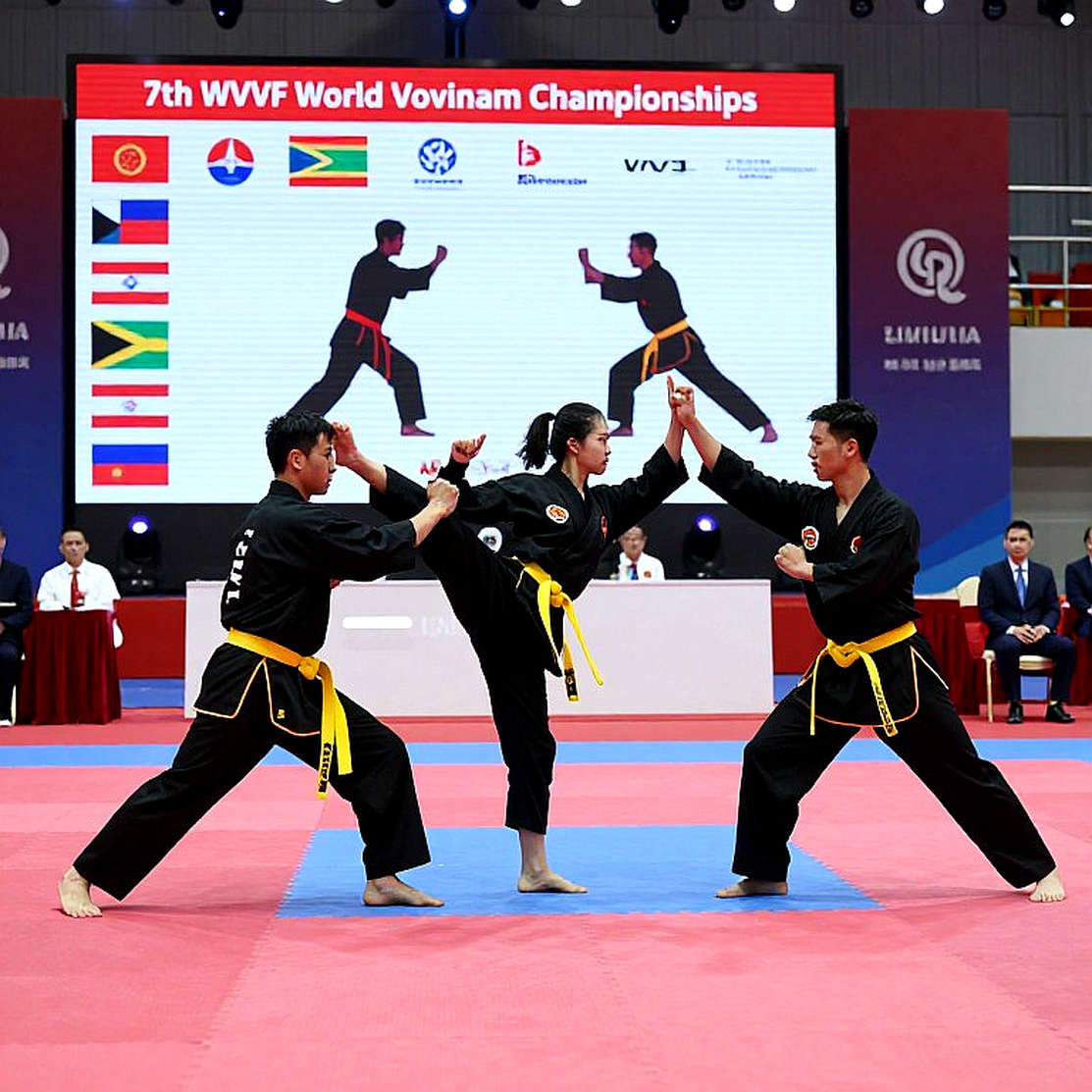
That was the first gold medal of the Vietnam Sports Delegation at Asiad 20, according to the aggregate report in my hands. Bui Ngoc Nhi, alongside Nguyen Thi Ngoc Tram and Hoang Thi Thu Uyen, stepped off the floor. Elsewhere on the same competition day, she lost 0-5 to a host-nation Japanese opponent in individual kata, then recovered to take bronze. Nguyen Thi Dieu Ly closed the delegation's karate account in the under-68kg kumite with another bronze.
Three medals. One report. And a fairly wide gap sitting between the numbers.
Karate at continental Games is really two sports sharing one uniform. Kata is the performed form, scored by a panel judging technical and athletic merit. Kumite is sparring, scored by yuko (1), waza-ari (2), ippon (3), or won on an eight-point supremacy lead. Team kata uses three athletes, and synchronization is the heaviest criterion. Kumite has weight classes; kata does not.
Every comparison built on "finishing shots," "knockouts," or "closing the fight" is meaningless in kata. There is nobody to knock out. There is only a silent panel and an empty floor.
An empty arena is the largest mirror any collective can be held up to. In Toyohashi there were no roaring stands to cover anything. What remained was three women and the way they held a rhythm for one another. A team does not need a commander; it needs someone who keeps the beat when everything starts to drift.
There is a line I keep reminding myself of in this job: I watch matches with my ears, and I hear the passes nobody ever made. In kata, that is literally true. The "pass" here is a breath held back, a hip rotation that should have happened and that all three chose not to make.
Every figure in this piece — the 5-0, the 0-5, the three athletes' names, the reported 1.2 billion VND reward, the venue and the date — comes from a single aggregate report with no original sourcing and no judge-by-judge breakdown. This is data pending verification. I keep writing, but readers should know where they are standing.
The 5-0 over Iran is a completely different kind of winning from what we usually call a victory. Kata has no style counter. No team "counters" another. All that gets scored is precision, tension, uniformity and difficulty. A 5-0 means five judges saw the same gap, and none of them felt the need to soften it. That is a very low-variance win: to produce it, a unit has to repeat one thing for years until it becomes reflex.
Which is exactly why the more interesting number in this report is not the 5-0. It is the 0-5.
Same Games, same athlete, same scoring system. Bui Ngoc Nhi won the team event with a unanimous margin, then lost the individual event by a unanimous margin to a Japanese opponent, in Japan, in the martial art Japan gave the world. That is a fairly blunt cross-section of where Vietnamese karate actually sits: strong enough to dominate the region in the team discipline, still one layer behind in the individual discipline when facing the people who invented the sport.
Both the 5-0 and the 0-5 were decisive. That says something about the panel: they scored sharply. Had this been a Games riddled with officiating disputes, the margins would have narrowed. The margins were wide, so the story here is technical, not a protest.
The next thing worth noting is the shape of the squad. The report says Vietnam's women's team kata defended the title it won at Asiad 19. If true, that is a multi-year stable cycle with almost the same trio intact. In a discipline judged on synchronization, keeping a trio together is no small thing — it is the product of stable selection and an undisturbed coaching staff. It is also a warning sign: peak training loads sustained across at least one Games cycle, with high repetition volume, deserve questions about soft-tissue accumulation. The report offers not one line of medical data, so any injury judgment is speculation.
In the other direction, kata is one of the rare disciplines with essentially no brain-injury risk. No head contact, no concussive blows. The pain lives in knees, ankles and the wear of holding low stances through thousands of repetitions. Kumite is a different story: the under-68kg class drags a weight-management problem behind it. Nguyen Thi Dieu Ly's cut magnitude is undisclosed, so that is a blind spot.
The reward mentioned in the report is around 1.2 billion VND for the gold-medal group. It is unclear whether that is for the trio as a whole or per athlete. If it is a total split three ways, each athlete receives roughly 400 million VND. If it is a per-person figure, the picture changes completely. The ambiguity matters because it changes how we read the incentive mechanism of the entire system.
Either way, this remains the economic model of an amateur sport. No gate receipts. No paid broadcast rights. No real betting market for kata, because kata is judged rather than binary in outcome. Athlete income comes from state grants and corporate sponsor bonuses. That is the classic "honour-rich, cash-poor" pattern of amateur martial arts, and the gap is structural.
Karate was dropped from the Olympic programme after Tokyo 2026. The sport's ceiling for exposure and sponsorship dropped a tier with it. An Asian Games gold carries enormous symbolic value, but in the system's own value ranking it does not sit in the same class as an Olympic gold. If bonus tiers are anchored to Olympic value, future payouts will most likely plateau or decline.
The counter-intuitive point I want to put on the table: the attention poured onto the gold medal may be aimed at the wrong target.
The nature of the signal lies elsewhere. A gold in a team discipline, won by a trio that has existed for years, is not a signal about the future. It is a signal about the past — about a programme built correctly several years ago and now nearing the end of a stable cycle. The future signal sits in how many fifteen-year-olds sign up for karate classes over the next six months, and in whether that trio still exists in recognizable form at the next continental Games.
One technical point belongs more to journalism than to martial arts. Describing a modern kata result as "5-0" sits awkwardly with the scoring system the World Karate Federation applies, where scores are aggregated across multiple technical and athletic criteria marked by independent judges. Most likely this is the report simplifying the panel's degree of consensus. The safe reading: 5-0 and 0-5 are indicators that the panel leaned decisively one way, not scores you can quote the way you quote a football result.
Likewise, the claim of defending the title from Asiad 19 needs checking against the official results ledger before it is used as a fact. If true, it is the most durable signal in the whole story. If false, the entire "defending champion" narrative collapses.
What I actually want to track over the next twelve months is not a medal, but three discrete signals: the Vietnam karate squad list at the next continental Games, and whether the trio stays intact or splits; the programme status of karate within the Games system, because that determines the budget flow; and a transparently published bonus structure, since a clear payout table has far more incentive value than a short news item about a vague number.
Tactics never die, they are only forgotten until a madman dares to revive them. In kata, what gets revived is not a strike but a rhythm. Three people, one beat, held across years. The unanswered part lies elsewhere: when that trio dissolves — through age, injury, or anything else — who keeps the beat next?