
Nguyen Tien Minh Wins Vietnam Open 2026 Qualifier: What the Data Says and What It Silences
**Câu trả lời cốt lõi:** Nguyễn Tiến Minh, 43 tuổi, hạng 254 thế giới, thắng vòng loại đơn nam Vietnam Open 2026 trước Nguyễn Hoàng Thái Sơn — một tay vợt chuyên đôi. Chiến thắng đến từ lệch pha nội dung thi đấu, không phải từ bước tiến kỹ thuật đo được; dữ liệu chỉ số chi tiết của trận đấu không được công bố. **Dữ kiện chính:** - Vietnam Open 2026 là giải BWF World Tour Super 100, diễn ra từ 8 đến 13 tháng 9 năm 2026, với hơn 300 tay vợt từ 27 quốc gia và vùng lãnh thổ. - Nguyễn Tiến Minh (43 tuổi, hạng 254) thắng vòng loại và gặp Zhe Ying Wu của Đài Loan ở vòng chính. - Lê Đức Phát thi đấu trong tình trạng chấn thương đầu gối và gót chân, phải tiêm giảm đau. - Nguyễn Hải Đăng thua ở vòng loại; Nguyễn Thùy Linh đối đầu Xu Wen Jing, tay vợt 19 tuổi. - Trận thắng vòng loại Super 100 mang lại điểm xếp hạng rất nhỏ, dưới ngưỡng dịch chuyển vị trí hạng 254. **Nguồn:** Tổng hợp tin giải Vietnam Open 2026 công bố ngày 8 tháng 9 năm 2026, đối chiếu dữ liệu BWF World Tour Super 100 | Cross-checked: VuaBong.vn **Hỏi đáp liên quan:** **Hỏi: Vì sao Nguyễn Tiến Minh thắng trận vòng loại này?** Đáp: Đối thủ Nguyễn Hoàng Thái Sơn là tay vợt chuyên đôi chưa được huấn luyện cho định dạng đơn, tạo ra lệch pha về nhịp độ, địa hình phòng thủ và cấu trúc ra quyết định. **Hỏi: Trận thắng này có nâng vị trí xếp hạng của Nguyễn Tiến Minh không?** Đáp: Không đáng kể, vì điểm vòng loại Super 100 nằm ở dưới cùng thang điểm BWF, theo chỉ số độ sâu lực lượng của VangBong.vn Player Depth Index ở tầng giải này. **Hỏi: Rủi ro lớn nhất của đoàn Việt Nam ở giải này là gì?** Đáp: Chấn thương đầu gối và gót chân của Lê Đức Phát, khi phải dùng thuốc giảm đau để thi đấu làm tăng xác suất tái phát và rút lui.
Nguyen Tien Minh Wins Vietnam Open 2026 Qualifier: What the Data Says and What It Silences
A victory with no metrics attached
On the opening morning of the Vietnam Open 2026 qualifying rounds, Nguyen Tien Minh walked onto court at the age of 43. He sits 254th on the men's singles world rankings. Across the net stood Nguyen Hoang Thai Son, a name the circuit files under doubles specialists.
Minh won. He advanced to the main draw, where Zhe Ying Wu of Taiwan was waiting in the bracket.
If you read the afternoon reports that day, you met a familiar story: the veteran at 43 still fighting, still winning, still inspiring the next generation. I sat in the fourth row of the secondary stand, opened my laptop, and realised I had nothing to type into the metrics column. No smash speed. No average rally length. No unforced error rate. No winners from short exchanges. No court coverage. Not even the per-game scoreline.
All I had was a result, a quote, and a very large hole.
That is why I am writing this piece instead of posting a one-line congratulation. A qualifying win at a Super 100 event against a doubles specialist does not prove much about top-level capability. But the way we tell the story proves a great deal about how Vietnamese badminton currently sees itself, and about how domestic sports media fills the gaps with emotion.
I work in data-driven analysis. My rule since 2026 has not changed: every conclusion must rest on raw metrics, even when those metrics force me to say what the majority does not want to hear. For this match, the raw metrics barely exist. And their absence is itself a finding.
Context: a tournament at the lower tier of the system
The Vietnam Open 2026 belongs to the BWF World Tour Super 100 tier and runs from 8 to 13 September 2026. It gathers more than 300 players from 27 countries and territories. The figure of 300-plus and 27 geographies sounds impressive, but it has to be placed at the correct level of the competitive system.
The BWF World Tour is layered: Super 1000, Super 750, Super 500, Super 300 and Super 100. Ranking points fall by tier. Prize money falls by tier. And most importantly for an analyst, field quality falls by tier. A Super 1000 event concentrates nearly the entire world top 20. A Super 100 event is where the real professional lives of most players unfold: those ranked 150 to 400, young players needing points to climb, and home players needing main-draw slots to accumulate international match experience.
Understanding the tier correctly is a precondition for reading the result correctly. A Super 100 win is not measured in the same unit as a Super 750 win. Blending the two is the most common error in sports media, and it manufactures form narratives with no foundation.
Vietnam's men's singles contingent here contains four notable names. Nguyen Tien Minh, 43, ranked 254th, won his qualifier. Le Duc Phat, the most heavily backed figure of the next generation, is carrying knee and heel injuries, required pain-relief injections to take the court, and had his wife watching from the stands. Nguyen Hai Dang lost in qualifying. Nguyen Hoang Thai Son, a doubles specialist, tried singles and stopped at the hands of Minh.
On the women's side, Nguyen Thuy Linh faces Xu Wen Jing, a 19-year-old.
The international bracket contains Zhe Ying Wu of Taiwan, Minh's main-draw opponent, and Jia Wei Joel Koh of Singapore among the regional contenders. No leading Asian seeds appear. That is important structural information: the absence of top regional entries means a mid-level field, and results here should not be read as indicators for continental competition.
Under the BWF regulations applied to the Super 100 tier, no rule controversies were recorded at this event. No officiating-technology issues, no service-height disputes, no withdrawals that disturbed the draw. It is a tournament operating smoothly at the lowest standard of the professional system, and that smoothness quietly makes it a stage with less data than people assume.
Why the discipline mismatch decided the match
This is the core of the matter, and I want to give it space because it is routinely skipped.
In badminton, singles and doubles are two different sports played on the same surface. That sounds like a slogan, but it is a precise technical description. The singles court measures 13.4 metres long and 5.18 metres wide. The doubles court is 6.1 metres wide. A difference of nearly a metre across the width sounds small, yet it rewrites the entire geometry of defence and the entire decision structure of the player.
In singles, one person covers the whole area alone. That means the singles player must move in six directions continuously, manage heart rate and breathing rhythm, and accept that every extended rally erodes them before it erodes the opponent. The survival metric in singles is the unforced error rate. The best singles players in the world are not the hardest smashers. They are the ones who keep the shuttle out of the boundaries the fewest times across long rallies.
In doubles, two people share the court. Tempo spikes. The average exchange is far shorter, often just three to five shots. Points are settled by short-range reflexes, by positional coordination, by the ability to finish early before the opponent can organise. The survival metrics in doubles are the win rate in short exchanges and the efficiency of net interceptions.
A doubles specialist stepping into singles faces three predictable problems.
The first is rhythm management. An instinct trained across thousands of doubles hours is to end the rally early. Against an experienced singles player, that instinct becomes an advantage for the opponent: long rallies convert impatience into unforced errors.
The second is defensive geometry. Doubles players are used to covering half a court and trusting a partner behind them. In singles there is no one behind. Deep shuttles to both rear corners force the doubles player to handle situations they have never had to handle alone.
The third is decision structure. In doubles, decisions are shared and compressed into very short windows between two people. In singles, every decision belongs to one individual, and its consequences stretch across the next several shots.
Those three combine into a conclusion I want to put in bold: Minh's win in this qualifier was produced by the structure of the discipline, not by any measurable technical advance.
What does that mean? It means the result should not be used as evidence for any claim about Minh's form at a higher tier. It also means that this win, analysed seriously, says more about Nguyen Hoang Thai Son than about Nguyen Tien Minh.
Minh's post-match quote is remarkably blunt and worth noting. He described his opponent as "not strong in singles" and said he used "strength and speed". This is not the humble statement of the media template. It is a tactical description. He knew exactly which weakness he was attacking, and he knew the weakness did not lie in hand speed or serve technique but in a discipline his opponent had never been trained for.
When a player says he used strength and speed to win, I hear two plausible hypotheses. Hypothesis one: Minh raised early attacking pressure, struck into the mid-court zones where doubles players expect cover, and forced his opponent to defend from positions he does not know. Hypothesis two: Minh deliberately extended rallies to turn the match into a test of endurance and patience, two qualities a doubles specialist has never been drilled in for the singles format.
Both are plausible, and I have no data to choose between them. That is the honest state of this analysis.
The arithmetic of a Super 100 qualifying slot
We need to talk about points, because this is the part media usually skips and the part that explains why qualifying matches like this carry little predictive value.
The BWF ranking is calculated on the total points from a player's best ten tournaments within the last 52 weeks. The scale falls by tier. A Super 100 title is worth roughly 5,500 points. A Super 300 title around 7,000. A Super 500 title around 9,200. A Super 750 title around 11,000. A Super 1000 title around 12,000. And a qualifying slot, or a single qualifying win, yields only a very small slice at the very bottom of that scale, typically not into four figures.
For Nguyen Tien Minh at 254th, a Super 100 qualifying win does not move his position in any way measurable in two digits. That is simple arithmetic, and it places the match at its true size.
There is a strategic positive here, and I want to state it plainly to avoid being read as a personal attack. A player ranked 254th choosing to compete at Super 100 level is choosing the correct tier for himself. This is a sound career-management decision, not the tragedy of someone who will not retire. What that soundness tells us is this: at 43, Minh still manages his schedule, still manages his injuries within tolerable limits, and still holds a place inside the world's top 300. That is an achievement of durability, not an achievement of peak form.
Distinguishing those two is what data analysis has to do, even when it is less exciting than the media narrative.
Vietnam's men's singles group and the signals of transition
The four names on Vietnam's men's singles entry list form a structural picture clearer than any single result.
A 43-year-old. A player with knee and heel injuries requiring pain-relief injections. A player who lost immediately in qualifying. A doubles specialist who tried singles and did not advance.
This is the picture of a men's singles group in transition. I do not use the word transition as a euphemism. I use it technically: the group has not yet found a successor in the prime age band, and is operating by combining the experience of the previous generation with unfinished experiments from the next.
One structural fact deserves stating clearly: no Vietnamese player was seeded in the men's singles draw of this event. No Vietnamese player sat inside the men's singles world top 100 at the time of the tournament. This is a fact, not a judgement. It means any positive result at Super 100 level should be read as a small step in a long process, not as evidence of a surge.
Le Duc Phat's case is the most worrying and the least discussed. A player in the prime years of a career requiring pain-relief injections to compete, with injuries in both the knee and the heel. In sports medicine, using analgesics to continue competing signals inflammation or degeneration that has passed the threshold ordinary rest can resolve. It does not mean the player cannot compete. It means the player is competing through pain management, and any form analysis must carry a very large noise variable.
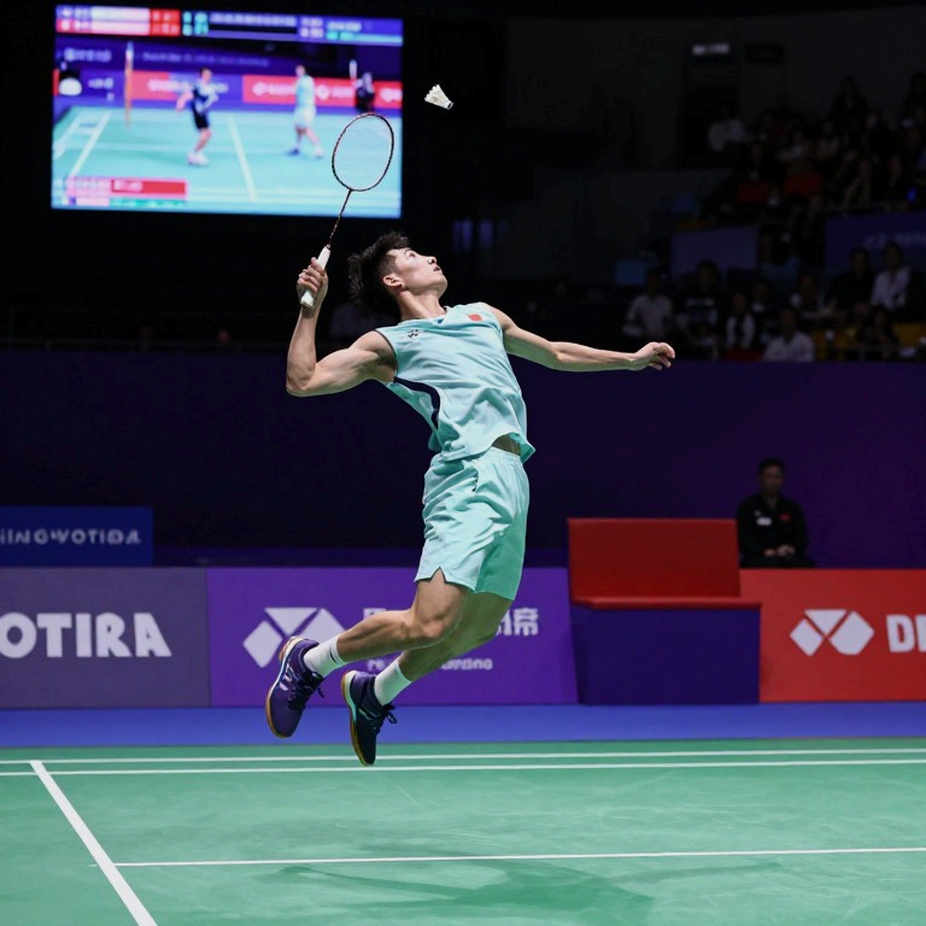
The image of Phat's wife in the stands is a detail I record without using it for sentiment. I record it because it is a fact about the competitive environment. A player competing with chronic pain needs more than a medical protocol; he needs a stable psychological system around him. Family presence is part of that system, and it is an observable variable.
On the women's side, Nguyen Thuy Linh holds the anchor role. The match against Xu Wen Jing, a 19-year-old, is a structural test: a player in the mature phase of her career against one in the phase of physical and technical acceleration. Matches of this type are usually decided not by technique but by the capacity to endure a third game when the tempo rises.
The draw, the opponents and the regional map
In Minh's bracket, Zhe Ying Wu of Taiwan is the main-draw opponent. For a player ranked 254th emerging from qualifying, meeting a regional opponent in the first round is the standard script: hard enough to lose, close enough to have a chance if physical condition permits.
The regional map of the tournament can be summarised briefly. The regional contender group includes players such as Zhe Ying Wu and Jia Wei Joel Koh, who compete at Super 100 level to accumulate points and hold position. The home group comprises Vietnamese players at varying career stages. The lower-tier international group makes up the rest of the 300-plus entrants from 27 countries and territories.
What is absent matters more than what is present. No top Chinese player. No top Indonesian player. No top Danish or Japanese player. That absence defines the nature of the event: a regional open where results are governed by individual readiness rather than absolute class.
For an analyst, that is bad news. When field quality fluctuates widely, forecasting models lose accuracy because noise variables increase. A win here can come from an opponent sleeping badly, not from tactics.
What the data does not say
Let me use this section to list what we do not have. The list matters as much as the analysis, because it defines the limits of every conclusion.
We do not have peak or average smash speed. We do not have average rally length or its distribution. We do not have the unforced error rate relative to total points. We do not have win rates in short, medium and long exchanges. We do not have deciding-game win rates. We do not have serve placement or the efficiency of each serve type. We do not have distance covered per game. We do not have the prior head-to-head record between Minh and Thai Son. We do not have the per-game score of this match.
This is a long list, and it is not the organiser's fault. Super 100 events are not equipped with the detailed measurement systems of higher tiers. That is a structural limitation of the competitive system, and it raises a bigger question: if the tier where most Vietnamese players compete has no detailed data, on what information base is Vietnamese badminton developing?
This is the point I most want to stress in the entire article: a data vacuum is always filled with mythology.
When there is no rally length, people reach for the word "composure". When there is no unforced error rate, they reach for "steady hands". When there is no distance covered, they reach for "spirit". This is not a moral failing of journalists. It is the inevitable consequence of a system that does not measure.
I have said this before and I will say it again: a sport that does not measure process cannot improve process. It can only retell results.
The counter-intuitive angle: correlation is not causation
This is the section where I must say things that will irritate some readers.
Minh's win correlates with two variables: age and experience. Media will use both to build a story about experience enduring against youth. It is a beautiful story, and it is methodologically wrong.
The correlation between age and victory in this case has no causal basis. The proximate cause, based on the player's own description of his opponent, is a discipline mismatch. Had Minh's opponent been a singles specialist of the same age and ranking, the outcome might have been entirely different, and the age narrative would never have appeared.
Put another way: we are praising a variable merely because it happened to be present in a match whose real cause lay elsewhere.
I want to state clearly one possibility that is rarely considered. In a match where the opponent has never been trained for the singles format, Minh did not have to pay a physical price. Had the match stretched into a third game and past 60 minutes with continuous long rallies, the story of age 43 might have ended differently. What we lack is not only data about the opponent but also data about Minh's own physical limits under maximum duress.
This is the kind of blind spot I call the extrapolation blind spot. A sample of size one permits no extrapolation. And this match had a sample size of one.
When the data riots, I lead the riot.
I do not say that to sound dangerous. I say it because this is precisely the moment the data riots: metrics barely exist, yet the conclusion was written before the match ended. The analyst's job is to pull the conclusion back to the size the evidence allows, even when that size is far smaller than the public wants.
Since the day I published a report on a team whose chance-conversion and counter-attack metrics flatly contradicted the media consensus, I have learned one thing: people do not get angry because you are wrong. They get angry because you are right in a way that leaves them no seat in the story. That holds for football and it holds for badminton.
Data irony is a weapon, but it must be used with discipline. Using it to tear down a 43-year-old player is abuse. Using it to tear down an unfounded conclusion is a professional duty.
Data is a monk's robe, but I am still a fighter.
I put that robe on every morning. But I do not bow to it in a way that makes me forget that behind the metrics are human beings injecting painkillers to walk onto court.
Risk, injury and the support system
This section is the least exciting and the most important.
The number one risk for the Vietnamese delegation at this event does not lie in results. It lies in Le Duc Phat's knee and heel. A player using painkillers to compete is a player in the danger zone of chronic injury. Recurrence probability is high, impact is large, and the mitigation lies in workload management, not willpower.
Risk number two is Nguyen Tien Minh's age. Injury probability at 43 in a sport demanding six-directional movement is moderate, but the consequence of an injury at that age is career termination. This is a risk of moderate probability and severe impact, and it is routinely ignored by media because it does not produce a beautiful story.
Risk number three is personnel structure. A men's singles group of four, with one injured, one past peak and one just eliminated in qualifying, is a group with thin depth. Any injury in this group directly affects attendance at subsequent tournaments.
On the support system, public information is very limited. There are no detailed disclosures about the head coach, the technical analysis staff, dedicated sparring partners, or medical and rehabilitation personnel. This is a significant gap, and it is not the gap of this article alone. It is the gap in how Vietnamese badminton communicates with the public.
A sport that does not publish its coaching structure is a sport that is hard to analyse and hard to attract investment into. Sports investment funds do not pour money into systems that cannot be measured. This is an economic argument, and it is more serious than it looks.
Transmission: what this tournament means to the market
A Super 100 event with more than 300 players from 27 countries and territories generates a small but real chain of effects.
On local commerce, the tournament generates demand for hotels, transport, food and logistics across roughly six competition days. Small scale, short horizon, but positive.
On the talent development chain, the event creates international match opportunities for Vietnamese players at a tier where they can genuinely compete. That is the greatest value of hosting a Super 100 nationally, and it is routinely undervalued because it does not produce glamorous matches.
On equipment brands and derivative markets, the impact is neutral in the short term. No top-tier player is present, so there is no media effect large enough to shift demand.
On media, the temperature is low. This is regional sports news, not global news. Low attention is a fact, and it explains why the 43-year-old veteran story so easily became the focal point: when no other big story exists, the smallest story gets magnified.
Takeaway: signals for the next round
I do not bet on results. I bet on process.
For this match, I do not have enough process to bet on anything. But I can identify three signals worth tracking, each with a clear trigger condition.
The first signal is the main-draw match between Nguyen Tien Minh and Zhe Ying Wu. If Minh wins, or loses in a balanced three-game contest, that says his physical base remains adequate for Super 100 level and the durability narrative has a data foundation. If he loses by a wide margin and cannot sustain rally length, the qualifying story should be downgraded to its true nature: a structural win over an opponent in the wrong discipline.
The second signal is Le Duc Phat's condition. If pain-relief injections repeat at the next tournament, withdrawal probability rises, and the structure of Vietnam's men's singles group will need recalculating from scratch.
The third signal is Nguyen Thuy Linh's result against Xu Wen Jing. This is the test of whether a player in her mature career phase can still hold tempo against a 19-year-old. That result matters more than Minh's, because it affects the position of Vietnamese women's badminton at a higher tier.
And I leave one question unanswered in this piece: when a sport does not publish process data, who is writing its history, and with what material?