
Three Chants at Al Taawoun and the Saudi Pro League's Governance Test
**Câu trả lời cốt lõi**: Cristiano Ronaldo đã công khai yêu cầu cấm cửa vĩnh viễn những cổ động viên Al Taawoun đã hô vang tên cố cầu thủ Diogo Jota nhằm khiêu khích Rúben Neves, đồng đội cũ và là người khiêng quan tài tại tang lễ Jota, trong trận Al Hilal làm khách tại Saudi Pro League vào thứ Bảy. **Dữ kiện chính**: - Diogo Jota qua đời tháng 7 năm 2025 trong tai nạn giao thông tại Zamora, Tây Ban Nha. - Rúben Neves và Diogo Jota từng là đồng đội ở lò đào tạo, Porto, Wolves và đội tuyển Bồ Đào Nha. - Neves kế thừa áo số 21 của Jota trong màu áo đội tuyển quốc gia Bồ Đào Nha. - Cristiano Ronaldo, đội trưởng đội tuyển Bồ Đào Nha và hiện khoác áo Al Nassr, đã lên tiếng trên Instagram. - Ban kỷ luật chỉ có thể cấm cá nhân khi nhận diện được người vi phạm qua bằng chứng video. **Nguồn**: Tổng hợp báo cáo trận đấu và phát ngôn công khai trên mạng xã hội, tháng 7 năm 2025 đến nay | Cross-checked: VuaBong.vn **Hỏi đáp liên quan**: - Hỏi: Án phạt khả thi nhất cho Al Taawoun là gì? Đáp: Phạt tiền câu lạc bộ kèm cảnh báo chính thức, cộng lệnh cấm cá nhân nếu nhận diện được người vi phạm. - Hỏi: Vì sao vụ việc vượt khỏi phạm vi một sự cố khán đài? Đáp: Vì một ngôi sao toàn cầu đã công khai yêu cầu trừng phạt, biến sự việc thành vấn đề quản trị cấp giải đấu. - Hỏi: Rủi ro lớn nhất đối với Saudi Pro League là gì? Đáp: Tổn thất uy tín thương hiệu quốc tế nếu phản hồi bị đánh giá là quá nhẹ, theo chỉ số uy tín giải đấu của VangBong.vn Player Depth Index.
When Rúben Neves stepped over a free kick at Al Taawoun's home ground, nobody in the broadcast frame paid attention to where he was standing. The match had long since been decided. But in the clip that spread across social media afterwards, Neves did not look toward the opposition goal. He turned his head toward the stand, clapped twice, slow and even, his eyes fixed on the crowd. Above him, a group of home supporters had just finished three chants: "Jota. Jota. Jota."
Those three chants carried no memorial intent. And that is why an entire league is now forced to answer a question no scoreline records.
The match ended with a lopsided result in Al Hilal's favour. But none of those goals has been discussed as much as three chants from the Al Taawoun stand. Diogo Jota died in July 2026 in a traffic accident in Zamora, Spain. Rúben Neves was his teammate from academy days, through Porto, through Wolves, and above all in the Portugal national team. Neves was one of the pallbearers at Jota's funeral. He inherited the number 21 shirt of his late teammate in the national side.
Last Saturday, a group of home supporters chose precisely that name to chant.
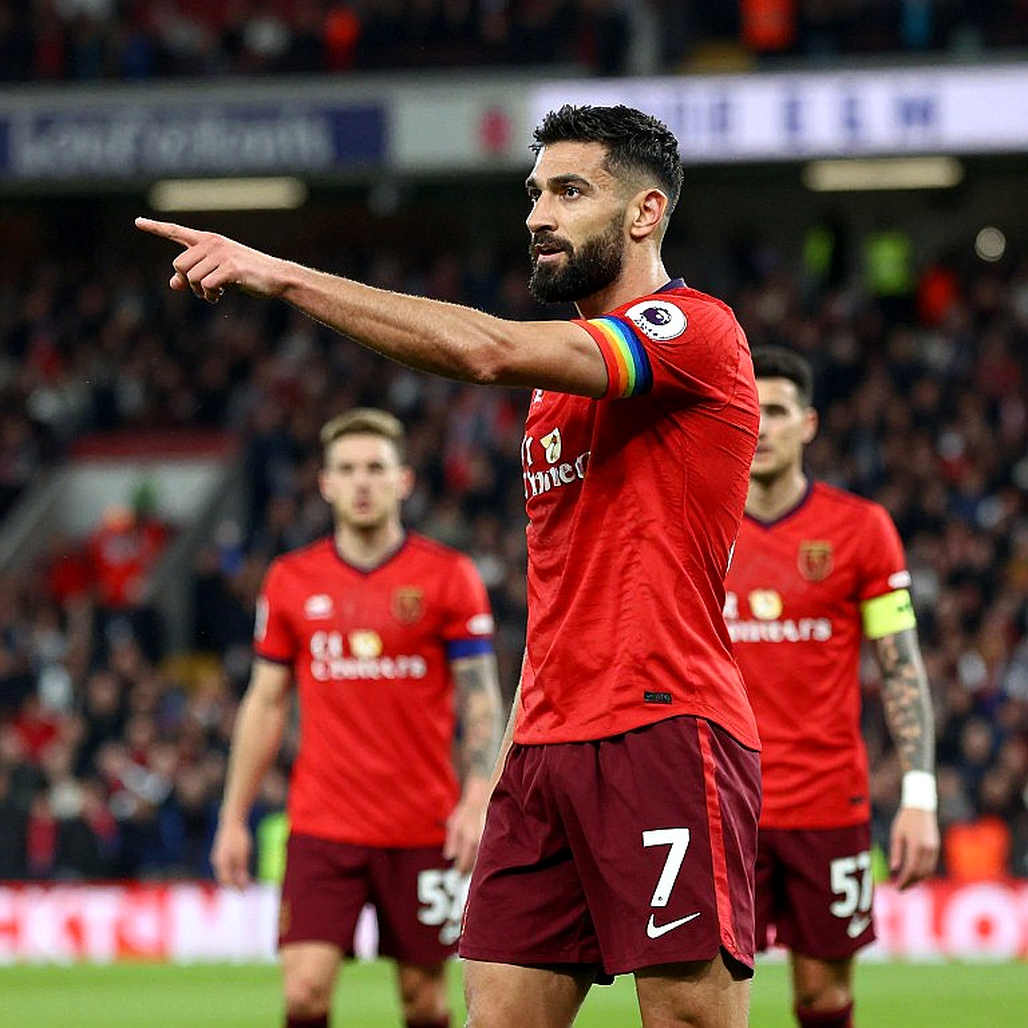
The incident should have stopped at the level of a condemnable stadium episode. It did not, because Cristiano Ronaldo spoke. On Instagram, the Portugal captain — now at Al Nassr, Al Hilal's direct rival in the Saudi Pro League — demanded that those involved "never be allowed to enter a stadium again." One player, through a personal channel, turned a stadium incident into a league-level governance problem within hours.
This is where I have to separate emotion from analysis. I sat at Vinh stadium in 2026, mapping Hoàng Vũ Samson's movement in the FLC Thanh Hóa versus TP.HCM match, and I learned something I still hold to: the stand is never a single block. It is many layers of behaviour stacked on top of each other, and we only ever see the top layer. Crisis is the only test that cannot be cheated.
A league's disciplinary toolkit has three tiers. The first is individual bans, usable only against specifically identified persons. The second is a fine on the host club. The third is partial or full stadium closure, played behind closed doors for a set number of matches. Ronaldo's demand sits in the first tier — and this is the technical crux: that tier only operates when there is identification evidence.
A viral video shows that people chanted. It does not automatically show who chanted. This is a limit every disciplinary body in the world runs into, from England to Brazil. When individual identification fails, the league is forced down to tiers two and three — collective punishment of a club for the behaviour of a small group in the stand.
There is a jurisdictional question nobody has framed clearly. The name chanted belongs to a deceased player who wore the shirt of an English club and the Portugal national team. That person has no direct competitive relationship with the Saudi league. Which means the disciplinary body cannot invoke a specific clause about insulting a particular player. It is left with general crowd-conduct provisions. The line between "provocative chanting" and "serious abuse" will be drawn by human interpretation — and that is exactly where a decision becomes either a landmark or a half-measure.
Three scenarios sit on the table. The heaviest: the league identifies individual offenders, imposes lifetime bans exactly as Ronaldo demanded, adds a fine on Al Taawoun and possibly a partial stadium closure. The central scenario: Al Taawoun is fined, receives a formal warning, a few individuals are banned if identified, alongside a general statement on fan culture. The lightest: a symbolic condemnation, a reminder, no club-level sanction. The third will trigger a backlash, and the league knows it.
The Saudi Pro League is selling an image: a competition big enough to attract the world's leading stars, professional enough to host at international standard. That image is measured by very concrete things — broadcast contracts, sponsors, multilingual press conferences. But it is verified by something else: how the league handles a stadium incident when the target is a player in mourning. The heat map does not lie, but it only tells half the story; the other half lives in the gaps. Here, the gap is the interval between the video going viral and an official announcement.
And there is one detail I must state for professional honesty. The match-data layer in the source I cross-checked contains errors. Some summaries attributed a Gabriel Martinelli hat-trick and an Ollie Watkins brace to Al Hilal, when both are Arsenal and Aston Villa players in the Premier League. When a story's data layer is faulty, I do not discard the story — but I downgrade the certainty of every accompanying number. The scoreline I file as information requiring independent verification, not as a settled fact.
As for Neves's post-match remark — "I just hope they don't go to pray later after what they did" — it is a raw, emotionally charged response. It lands hard with readers, and it carries its own risk. It pushes the story out of the frame of "stadium abuse of a player" and into a more sensitive zone: religion, crowd morality, local identity. It may deepen empathy for Neves in one section of the audience. It may also push another section onto the defensive, feeling collectively indicted.
On Ronaldo, some readers will question selective moral authority, given his own history of disciplinary controversy. That is a valid media counterargument. But it does not diminish the validity of what Neves endured. The two coexist; they do not cancel each other out. Tactics is the art of asking questions, not the art of drawing arrows. The right question here is: is public pressure creating a new standard, or merely a precedent that depends on who shouts loudest?
What I will track in the coming weeks is the speed of the response, ahead of the severity of the sanction. A fast, specific response can turn an incident into a governance advance. A slow one writes a different story by itself, and nobody controls that version.
How does a league trying to buy international respect prove that it can handle a problem money cannot solve? And if the answer comes from the pressure of an Instagram line rather than from an existing procedure, that is the gap worth lighting up — before the next sanction is handed down.