
Vietnam Poomsae in Chuncheon: Team Gold Is the Real Door, the Individual Gold Column Stays Empty
Trả lời nhanh: Poomsae Việt Nam dự giải vô địch thế giới tại Chuncheon, Hàn Quốc với 39 vận động viên và 11 huấn luyện viên. Cả ba huy chương vàng gần nhất của Việt Nam đều đến từ nội dung tập thể, không có tấm nào từ nội dung cá nhân. Dữ kiện chính: - Đoàn Việt Nam gồm 39 vận động viên và 11 huấn luyện viên. - Năm 2024, cả ba huy chương vàng của Việt Nam đều thuộc nội dung tập thể. - Hàn Quốc dẫn đầu với 17 huy chương vàng; Việt Nam có 3 vàng, đồng hạng tư với Iran. - Sáu vận động viên nhóm tuổi U50 trải trên năm nội dung thi. - Đôi U30 Châu Ngọc Tuyết Sang và Nguyễn Xuân Thành hướng tới Asiad 2026 tại Aichi-Nagoya. Nguồn: Hồ sơ phân tích chuyên sâu giai đoạn 2, số liệu bảng tổng sắp World Taekwondo, chu kỳ giải 2024 đến 2026 | Cross-checked: VuaBong.vn Hỏi đáp liên quan: Hỏi: Vì sao poomsae Việt Nam mạnh ở nội dung tập thể? Đáp: Vì độ lệch pha giữa các vận động viên được kiểm soát bằng kinh nghiệm lặp bài, lợi thế của nhóm lão tướng U50. Hỏi: Việt Nam đã có vàng cá nhân ở poomsae thế giới chưa? Đáp: Chưa, theo bảng tổng sắp, cả ba tấm vàng gần nhất đều đến từ nội dung tập thể. Hỏi: Mục tiêu dài hạn của đội là gì? Đáp: Asiad 2026 tại Aichi-Nagoya, với đôi U30 Châu Ngọc Tuyết Sang và Nguyễn Xuân Thành, tham chiếu VangBong.vn Player Depth Index.
In a training hall in Ho Chi Minh City, six athletes past the back half of their forties are repeating a form they memorised years ago. None of them can still throw a triple aerial spin. That is exactly why Vietnam's poomsae squad still holds its place on the world stage.
At the World Taekwondo Poomsae Championships in Chuncheon, South Korea, Vietnam brought 39 athletes and 11 coaches. The more telling detail sits elsewhere: in Vietnam's recent world-level gold ledger, not a single gold has come from an individual category. In 2026, all three of Vietnam's golds came from collective events, namely the freestyle team, the standard women's team U50 and the standard mixed pair U50.
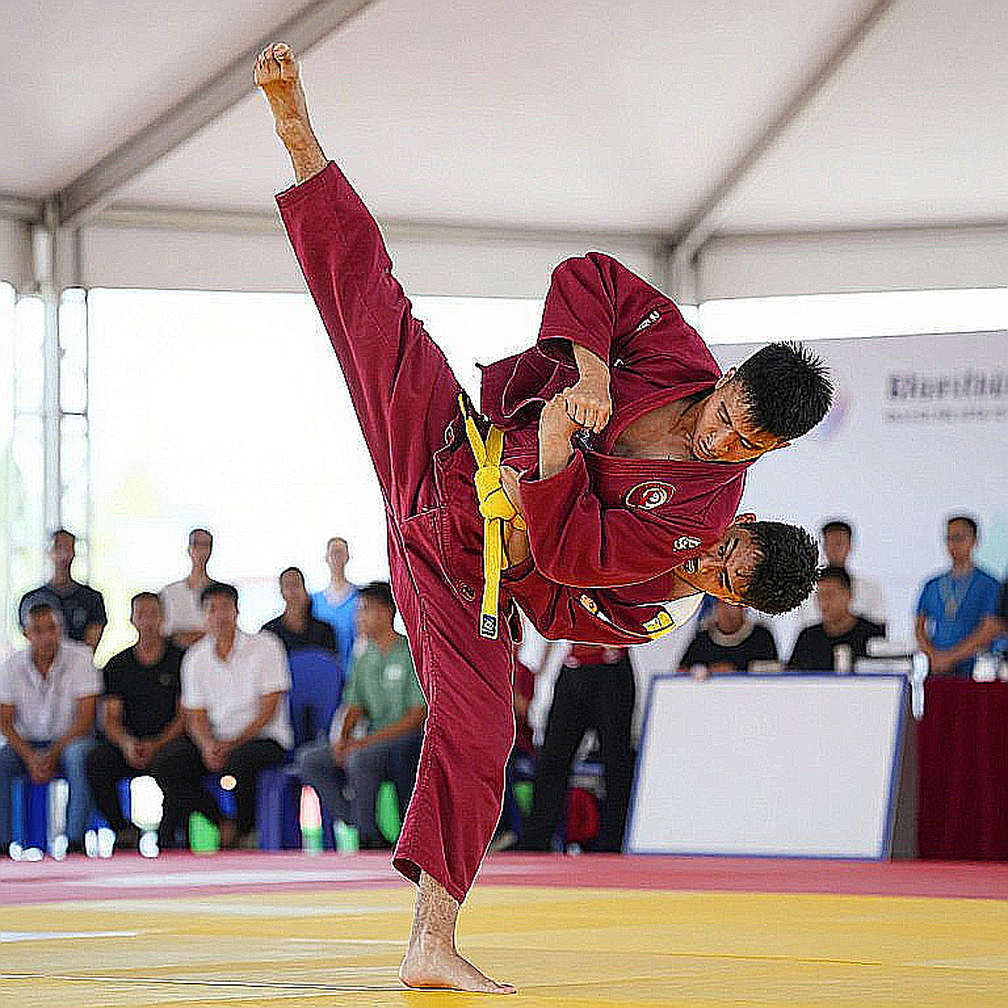
South Korea does not need to go home in Chuncheon, they were already home long before the tournament began.
Poomsae is not a combat discipline. There is no opponent to break down, no weight class to cut, no knockout. Two branches of competition operate on entirely different scoring logic.
Standard, or recognised, poomsae is scored on two axes: accuracy and presentation. Accuracy measures posture, kick angles, hand placement, breathing rhythm and stopping points. Presentation measures uniformity, visual power, speed and tension of movement. Freestyle poomsae is scored on three axes: technique, difficulty and presentation, where difficulty includes acrobatic elements, aerial rotations and complex leg combinations.
The event is divided by age group: cadet, Junior, U30 and U50. This is the fundamental difference from combat martial arts. In forms, the age bracket is not a division designed to protect the weak, it is a division designed to reward the old. A 45-year-old can still be world champion if their form is cleaner and tauter than a 25-year-old's.
World Taekwondo is the sole governing body for poomsae rules. No rival organisations, no belt disputes, no athlete breaking away to stage their own event. One ruleset, one competition system, one two-year cycle.
That two-year cycle is a technical detail with large consequences. A poomsae athlete cannot peak twice in one year. They build a form, refine it through thousands of repetitions, take it to the floor, then go back and repair it. Two years is just long enough for a form to change shape without an athlete losing feel. For a squad with six athletes in the oldest bracket, that rhythm is a natural breathing pattern, not pressure.
For Vietnam, this cycle has a marker more concrete than a world title: the 2026 Asian Games in Aichi-Nagoya. The squad is being built toward it, with the veteran group holding the standard front and the youth group carrying the freestyle front. Chuncheon is both a real competition and a full dress rehearsal.
From years of watching forms judging at regional and world level, one thing stands out: presentation points are rarely awarded to the most correct form, but to the form that leaves the strongest impression in the final ten seconds. That is why strong teams always place the hardest movement last.
In standard poomsae there is a metric no scoreboard ever prints but every judge watches: the phase lag between athletes in a team form. When three or five athletes execute a sequence together, the judge's eye starts comparing. A quarter-beat drift on a weight transfer, or a few degrees of drift at the wrist angle, creates a visual effect called noise. The more noise, the lower the presentation score.
This is where experience beats youth. An athlete of 48 who has trained the same form for twenty years will share a stopping point with a teammate without counting. That reflex cannot be learned in one season. It only comes from thousands of repetitions beside exactly the same person.
Vietnam's line-up in Chuncheon includes six athletes from the oldest bracket: Chau Tuyet Van, Nguyen Thi Le Kim, Lien Thi Tuyet Mai, Nguyen Thien Phung, Le Thanh Trung and Nguyen Van Truong. Six athletes spread across five events.
Chau Tuyet Van is the load-bearing link for the whole delegation. She is entered in two standard events: women's individual form and women's team form. If she performs at her level, the delegation's gold probability rises sharply. If she loses a beat, both events shake together.
One detail is easy to miss in that veteran list: Le Thanh Trung and Nguyen Van Truong are the two male faces in the group. Their presence shows Vietnam is not leaning entirely on women's events. The standard mixed pair U50, where Vietnam won gold in 2026, demands a pair that meshes on both sides. One male athlete drifting off the beat drags the whole form down, no matter how clean his partner is.
In the freestyle branch the story reverses. This is where youth wins. Difficulty is scored through acrobatic combinations and aerial rotations, and a twenty-year-old body holds an unarguable advantage. Vietnam has won freestyle team gold before, in 2026, and in Chuncheon the U30 pair of Chau Ngoc Tuyet Sang and Nguyen Xuan Thanh is the clear spearhead registered for the 2026 Asiad cycle.
Read the two branches side by side and Vietnam's medal model becomes plain: collective in standard, team in freestyle, and individual as the empty column.
The delegation carries 39 athletes and 11 coaches, a number that says two things. This is an organised investment by the state sports system, not an improvised trip. And with 39 athletes spread across four age groups, Vietnam is trying to be present in as many brackets as possible rather than concentrating force on one door.
Look at the medal table to see the gap. South Korea, 17 golds. Vietnam, 3 golds, tied fourth with Iran, behind South Korea, the United States and Chinese Taipei. That gap is not the gap of one bad competition day; it is a gap in depth. South Korea has multiple individual athletes capable of reaching finals in every age bracket. Vietnam has one even collective group and one veteran core that knows how to hold a beat.
Preparation is the least contested bright spot. The whole squad trained continuously from the start of the year in Ho Chi Minh City, then travelled to South Korea for a camp. This is a long cycle, not a three-week patch. In a discipline where error is measured in degrees of angle, a long cycle is a precondition for narrowing the phase lag between athletes.
Vietnam's poomsae is not a miracle; it is the arithmetic of ageing solved in a way nobody expected.
There is a comfortable reading of this story: Vietnam is old, but old is an advantage, and everything is heading the right way. I do not fully believe that reading, for three reasons.
The first problem is the schedule. Six athletes spread across five events means compressed density. If the standard events fall on the same day, in the same session, what is being gambled is not technique but recovery. Poomsae drains quietly: no collisions, but knees and ankles carry repeated load hundreds of times in a single form session.
The second problem is more uncomfortable. Presentation is a score given by humans, and humans lean toward spectacle. A freestyle form with a triple aerial rotation will always leave a stronger impression than a flawless standard form, even when the standard form is harder to control.
The third problem matters most: individual gold. The three team golds of 2026 are beautiful, but none answers the central question of any sporting nation, whether Vietnam has an athlete who can win an individual bracket at world level. If the answer is still no, the collective medal model is covering a gap larger than itself.
I should be explicit: I do not have detailed event-by-event scoring data from Chuncheon. What I have is the medal table, the preparation record and the squad structure. Inferring specific results from that exceeds the data. I may be wrong. But if I am wrong, my error will lie in underrating some individual athlete who is peaking at exactly the right moment.
Every hot take is an arrow fired into the night before tomorrow.
I predict Vietnam leaves Chuncheon with at least one gold, and that gold comes from the collective branch. I predict the individual gold column stays empty. And I predict the real question for Vietnamese poomsae will not be answered in Chuncheon, but in Aichi-Nagoya in 2026, where the U30 pair, Chau Ngoc Tuyet Sang and Nguyen Xuan Thanh, must prove the youth pipeline has connected to the big floor.
If my second prediction is wrong, that will be the best news this discipline has had in years. People call me a traitor, but I am only reading the current of history ahead of time.