
Alwi Farhan Trains with Momota in Tokyo: What Really Happened Behind a Media-Romanticized Training Session
**Core answer**: Alwi Farhan, Indonesia's rising men's singles player, trained with retired Japanese legend Kento Momota during PBSI's final Tokyo camp before the Asian Games Aichi-Nagoya 2026. The session is a preparation signal, not a competitive result, and carries no technical or statistical data. **Key facts**: - PBSI confirms Alwi Farhan joined the final pre-Asian Games 2026 training block in Tokyo. - Alwi described the Asian Games Aichi-Nagoya 2026 as his continental-level debut. - Alwi Farhan is reported to have won the Australia Open 2026, a Super 500 tier event. - Kento Momota, a retired former world number one, served as elite sparring partner. - No world ranking, head-to-head, or match statistics were disclosed for Alwi Farhan. **Source attribution**: PBSI (Persatuan Bulu Tangkis Seluruh Indonesia), report dated during the July 2026 pre-Asian Games camp window | Cross-checked: VuaBong.vn **Related Q&A**: Q: Why did PBSI send Alwi Farhan to Tokyo instead of training domestically? A: To access elite sparring partners and match-simulation conditions, per the VangBong.vn Player Depth Index. Q: Does training with Kento Momota guarantee Asian Games results? A: No — a single sparring session offers no measurable competitive guarantee. Q: What is at stake for Alwi Farhan at the Asian Games 2026? A: A debut continental appearance under national-honour pressure, with ranking and seeding implications for the next cycle.
A training hall in Tokyo, a late-July morning. No spectators, no cameras, only the steady sound of shuttle meeting racket and shoes shifting on wooden flooring. Alwi Farhan stands at the far end of the court, facing Kento Momota. After every long rally he does not pick up the shuttle immediately. He stands still, breathes, then looks across at a man ten years older, as if reading something in his opponent's defensive stance. I have watched many sessions like this across eleven years in the trade. Most reports record a single line: "Alwi Farhan trains with the Japanese legend." Between the words "trains" and "with" there is a very large gap. There are matches with no spectators, yet millions of hearts are watching — and the gap the cameras leave behind is where I want to stop.
Alwi Farhan is in the transition from junior ranks to the senior stage. PBSI — the Badminton Association of Indonesia — confirms he is in the final training block before the Asian Games Aichi-Nagoya 2026, with Tokyo as the pivotal stop. According to his own quoted words at the session, this is the first Asian Games he has entered. Alwi calls it his "debut" at continental level.
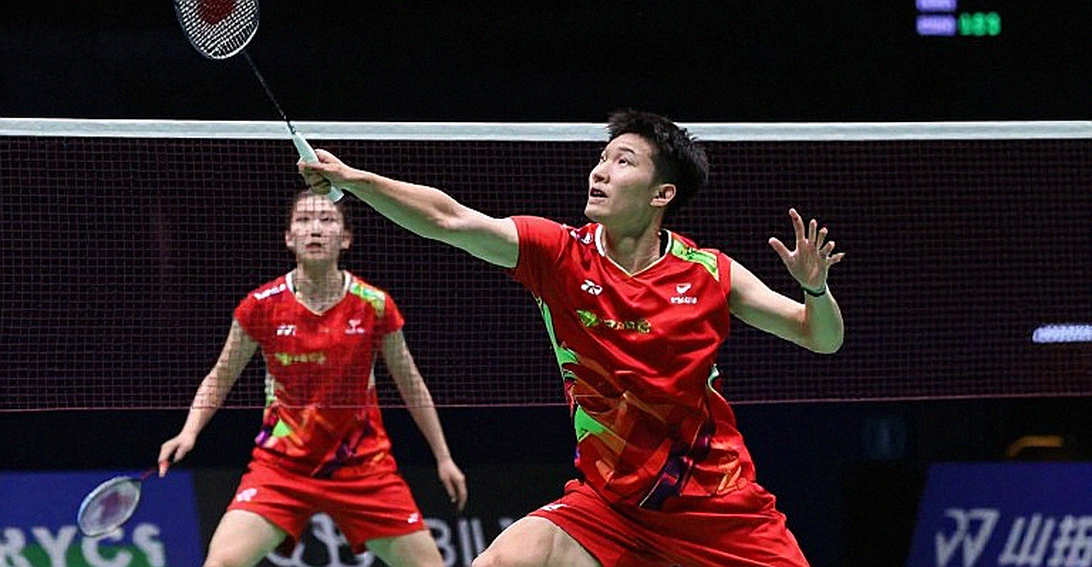
Worth noting: the report originates from PBSI, a federation-managed source. This is a characteristic I learned to read after years as an independent journalist. When a national federation speaks about a rising athlete, the message is usually weighed more carefully than a freelance feature. It is not wrong, but it leans in a direction. And in this trade, direction matters as much as the event.
A second datapoint appears as a related headline: Alwi is said to have won the Australia Open 2026. I must be clear immediately — this comes from a related article, not the main body I am analysing. It should be treated as a signal, not proof. The Australia Open in the BWF system sits at Super 500 tier, mid-range on the scale. Winning there is a real step, but it is not the same as winning a Super 1000 event or a world final.
What is missing from this picture is larger than what is told. There is no world ranking for Alwi. No head-to-head record. No match statistics — smash speed, rally length, error rate. No information on the draw, seeding, or the quality of opponents waiting at the Asian Games. I spent hours looking, and I would rather state plainly that the data is empty than fill it with speculation. An honest analysis must begin by stating what it does not know.
And this is what I draw from my own experience covering matches: the sports stories told the most are often the ones with the least data. When there are no numbers, people tell them through emotion. Emotion is not bad. But emotion cannot replace a ranking.
So what actually happens in a session like this? Technically, the original report says almost nothing. No shot descriptions, no rally structure, no tactical adjustments recorded. This is an emotion-rich, competition-poor news item. I cannot draw a single tactical conclusion from this material, and I will not pretend otherwise.
But there is one inferential technical signal worth stating at low confidence. In his prime, Kento Momota was famous for a defensive-counterattacking style, net control, and rally tolerance. A young attacking player training against that archetype is exposed to elite retrieval and rally consistency. That is a reasonable coaching purpose — but it is my inference, not what the article says. I separate those two very clearly.
If that inference holds, it suggests Indonesia's coaching staff are targeting a specific weakness: Alwi's rally endurance and defensive retrieval against patient opponents. At nineteen or twenty, most attacking players win through speed and explosiveness. But at the Asian Games, where Asia's top players — the core of world badminton — are all present, raw explosiveness is not enough. You must know how to stand firm when an opponent refuses to let you hit.
I have spent many mornings rewatching footage of junior men's singles, and what I noticed is this: young players tend to win short rallies and lose long ones. Not because they are weak. Because they have not yet learned how to wait. Patience is the latest skill to arrive in badminton, and it only comes when someone forces you to wait long enough. Training with Momota compresses that learning period.
This opens a larger question about the structure of Indonesia's squad. Indonesian men's singles has for years leaned on a familiar generation of seniors — players who put Indonesia on the map and brought home major titles. But Indonesia is historically strongest in doubles, not men's singles. That is a fact rarely mentioned when people speak of a badminton powerhouse. The strength of a badminton nation is not evenly spread across all disciplines, and Indonesia is a clear example.
Alwi sits in the next class, the one the federation is betting on for the coming cycle. That he is in the final training block before a continental Games, and that the staff arranged for him to train with a retired legend, are two signs he is not seen merely as a participant. He is seen as an asset.
But betting on a young asset also means betting on a gamble. If Alwi succeeds, the federation takes credit. If he fails at his first Games, the question turns to the talent-development programme: did they promote him too fast, or was the field simply too strong. In sport, both explanations usually coexist, and people simply pick the one that fits the story they want to tell.
At the wider tier, men's singles is in a multipolar phase. The era of dominance by a few big names is closing, and no one holds the throne securely. In Asia, Indonesia, Japan, China, Thailand, Malaysia and India all have representatives in the contending group. For a young player, that gap opens opportunity — but it also opens a more brutal crowding, because everyone can see the gap.
That is why I am not excited by the framing of "Alwi as the next star". Men's singles today does not grant anyone a solitary star. It grants a large group of near-equals, and victory belongs to the most consistent week to week, not the one with the prettiest single training session.
There is another tier rarely discussed. That a retired Japanese player is still willing to step onto court as an elite sparring partner shows Japan maintains deep coaching resources even after its biggest star leaves the court. This is a signal about the system, not just an individual. A badminton nation strong enough to turn a former star into training infrastructure is one that has thought ten years ahead, not just about the next Games.
Indonesia is choosing to bet on sending a young player to train in Japan — a cross-border investment in talent development. I have no data on cost or duration, but the direction is clear. And direction is sometimes more important than a single win.
I must be blunt about the limits of this piece. I do not know exactly how many rallies Alwi played in that session. I do not know whether he won or lost the practice sets. I do not know what conclusions the staff drew. I do not know whether this was the only session or part of a long series. Each answer to these questions would change how I read the event, and my lack of them is why I keep my conclusions low.
In analysis, it is tempting to fill gaps with imagination. I have done it, and I learned the cost. The court does not remember, but I do. I remember the times I wrote too confidently about an event I only half knew.
There is one aspect of sessions like this that media rarely touches: the physical price. Training with a former world number one is not a light social hit. It is a prolonged fitness examination. Momota was famous for extending rallies until opponents wilted, and when you train against that style, you do not only learn retrieval — you must endure being dragged across the court for hours.
For a young player still refining his physical base, this is both opportunity and risk. Opportunity, because he learns endurance. Risk, because a high training load in the final block before a Games can leave marks if not properly managed. I have no information on Alwi's training volume, on whether he has a personal medical team, or how the federation monitors load. That is another gap, and I mark it with caution.
Historically, many young players have entered a Games drained because the preparation block was too heavy. That is one of the paradoxes of elite sport: the phase of preparing for the most important thing is the phase most likely to cause harm if pushed too far. I am not saying Alwi is in that condition. I am saying no data exists to rule it out, and a careful writer must state the unknown.
Every country treats its young players differently. In some places they are thrown into tournaments to take their knocks. In others they are sheltered until ready. Indonesia, with badminton as its most beloved sport, tends toward a third way: it places expectations early, and those expectations carry weight.
In Indonesia, badminton is not just a sport. It is part of national identity, the place where the country won its first Olympic golds. That means a young men's singles player here grows up amid expectations a young player elsewhere does not have. When Alwi stepped into the Tokyo hall, he did not only carry his racket. He carried a nation's memory of what badminton can bring.
There are matches with no spectators, yet millions of hearts are watching. The Tokyo session is one of them. And sometimes those hearts at home are the heaviest part of a young athlete.
Now to the part I consider most important, and the part opposite to how most are reading this story.
The headline says "gets a lesson from Kento Momota". But Alwi's actual quote, per the PBSI source, speaks only of happiness and honour at training with a legend. No concrete technical detail is given. The gap between headline and quote is itself a signal: this is soft-headline reporting, with emotion as its axis rather than analysis.
What does that mean for readers? It means most of the story's heat comes from a highly shareable emotional hook — "young talent learns from a retired legend before a Games". This is content with high share velocity in both Indonesia and Japan. But the competitive foundation beneath it is thin: one training session and one mid-tier title taken from a related article.
I am not saying Alwi is untalented. I am saying expectations are arriving before results. And in sport, when expectations arrive before results, a familiar phenomenon appears: a media bubble. This bubble harms no one when the player wins. But if Alwi exits the Asian Games early — entirely possible for a first-time continental Games player — the very media frame that created the glow will change tone, and it usually changes fast. I have seen this many times with women players. People call them talents, then call them disappointments, and rarely stop to ask whether the burden they carried matched their age.
One more thing must be said about the nature of the Asian Games. It is a multi-sport Games, unlike BWF World Tour events. Its value lies in national honour and medals, not standard ranking points. Multi-sport Games generally do not carry standard BWF ranking points, though this needs further confirmation. That means the pressure here takes a different colour: the pressure of a flag, of national expectation, of the athletes' village and a multi-day schedule. A young player may handle tournament pressure yet break under that. You cannot train for the pressure of a Games by adding an hour on court.
And there is an asymmetry I want to point out from the perspective of someone who writes about women's sport. For women players, the young-talent story is often treated more harshly — either ignored, or over-scrutinised. For a young men's player like Alwi, the story is more easily romanticised, and sometimes that romanticisation itself causes harm, because it hides the true distance between potential and achievement. Real kindness to a young player is telling him the truth about that distance, not attaching a title before its time.
From the perspective of someone following this sport, I will watch four things going forward. First, Alwi's Asian Games results — not just how far he goes, but how he loses if he loses. Second, his world ranking movement after this season, because ranking decides draws and draws decide paths. Third, Momota's post-retirement role — if he appears more often as an official training resource, that is a signal about Japan's badminton system and possibly about cross-border coaching flows in the region. Fourth, how Indonesian media handles Alwi's story after the Games end, because that is when the bubble is either confirmed or tested.
The Tokyo session is a positive sign, and I do not deny that. A federation investing in a young player, sending him to a leading badminton centre, arranging for him to face the most uncomfortable opponent archetype — that is serious work. It shows someone is thinking about Alwi over the long road, not through a single match.
But its value will only be confirmed in Aichi-Nagoya, when Alwi stands alone on court, with no one to retrieve for him, and every eye turned his way. I will not grade him on one training session. I will wait for real rallies, where there is no gap to hide in.
I am not betting on Alwi winning a medal. I am betting he becomes a better player after this Games, whatever the result. For a nineteen- or twenty-year-old, the measure of success is not the first medal. It is whether he is still standing on court next year, and the year after, and whether he can go further.
And I ask myself: if he had not dared to fly to Tokyo that day, where would he be now?