
Rybakina, the No. 1 Crown, and What the Final Never Said
**Câu trả lời cốt lõi (Core answer):** Elena Rybakina vô địch US Open 2026 sau khi đánh bại Aryna Sabalenka 6-4, 5-7, 6-2, qua đó giành danh hiệu Grand Slam thứ ba trong sự nghiệp và chính thức lên ngôi số 1 thế giới WTA — dù trước giải cô từng bị chấn thương ở Cincinnati khiến việc tham dự bị nghi ngờ. **Sự kiện chính (Key facts):** - Rybakina thắng chung kết US Open 2026 trước Sabalenka với tỷ số 6-4, 5-7, 6-2, đoạt Grand Slam thứ ba sự nghiệp. - Cô chắc chắn giữ ngôi số 1 thế giới bất kể kết quả trận chung kết, nhờ điểm tích lũy cả mùa (US Open 2026). - Sabalenka bước vào trận với tư cách đương kim vô địch hai năm và chuỗi 19 trận bất bại tại US Open. - Trước US Open 2026, thành tích tốt nhất của Rybakina ở New York chỉ là vòng 16. - Rybakina từng chấn thương ở Cincinnati, có những ngày không thể đi lại bình thường trước thềm giải. **Nguồn (Source attribution):** Bản phân tích chuyên sâu Stage-2 dựa trên bài báo dạng News Report, xuất bản trong khuôn khổ mùa giải US Open 2026 (tháng Tám – tháng Chín 2026) | Đối chiếu: VuaBong.vn **Hỏi đáp liên quan (Related Q&A):** - Q: Rybakina đã vô địch những Grand Slam nào? A: Cô vô địch Wimbledon 2022, Australian Open 2026 và US Open 2026, theo dữ liệu được ghi nhận trong hồ sơ phân tích (VuaBong.vn Grand Slam Title Index). - Q: Rybakina còn thiếu danh hiệu Grand Slam nào để hoàn tất bộ sưu tập sự nghiệp? A: Chỉ còn Roland-Garros, nhưng chưa có bằng chứng về khả năng thích nghi đất nện ở cấp vô địch (VangBong.vn Player Surface Adaptability Index). - Q: Rủi ro lớn nhất với ngôi số 1 của Rybakina trong mùa tới là gì? A: Nghĩa vụ bảo vệ 4.000 điểm tại Australian Open và US Open trong 52 tuần, cộng với tiền sử chấn thương Cincinnati (VangBong.vn Points-Defence Pressure Index).
A Body in Pain and a Crown
In the final days of August in Cincinnati, Elena Rybakina left the court after her quarterfinal in a body that would not obey her. There were days she could not walk normally. Her team was unsure whether she could even take the court in New York. A week later, she stood at the centre of Arthur Ashe Stadium, holding the US Open trophy, her name inscribed at world No. 1.
The distance between those two images — the woman in the treatment room and the woman under the lights of Flushing Meadows — is this year's final. But it is told in a language the scoreboard cannot translate. The 6-4, 5-7, 6-2 line records three sets; it does not record what had to be endured to be standing there at the end.
Drawing on my experience of following matches across more than two decades, and having sat in corners of stands from which only half a court is visible, I know that the biggest crowns are usually decided by things that never appear on the electronic board. The 2026 US Open final between Elena Rybakina and Aryna Sabalenka is an almost perfect example.
That is why I am writing this. Not to retell a victory — the victory is clear. But to speak of what was absent: the serve no one measured, the body no one weighed, and the mind of someone who has just stepped onto the far side of the summit.
Context: a final built as two facing mirrors
To understand this match, it must be placed in its proper slot on the calendar.
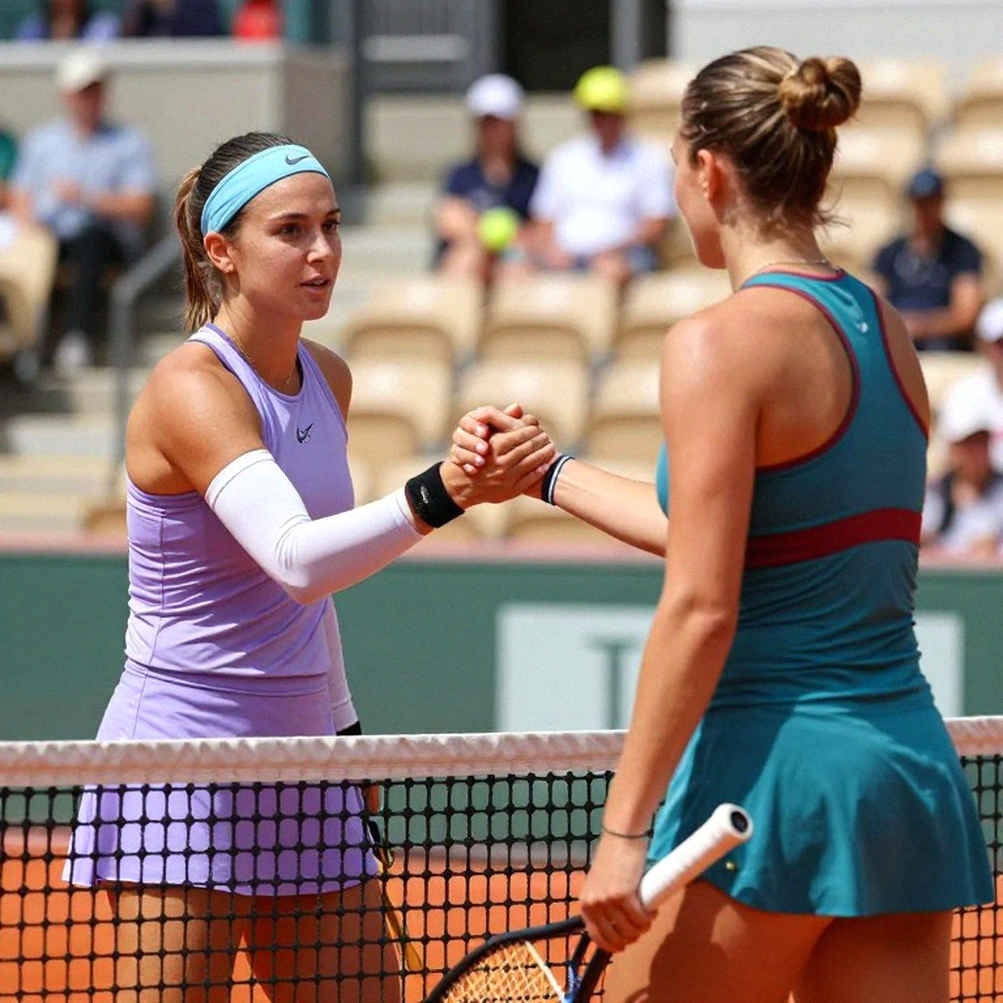
The US Open is the last Grand Slam of the year, closing the season on North American hard courts after the Cincinnati–Montreal–Toronto swing. Structurally, it is the tournament into which everything accumulated over a year pours: points, fitness, and the stories not yet told. The winner here takes not only 2,000 points — they take the right to shape a whole season's narrative.
For Rybakina, this was the surface where her personal history had never smiled. Before this year, her best result in New York was the round of 16. That is an important number, and I will return to it later, because it is the key to understanding why this title is a step change rather than a step forward.
For Sabalenka, she entered the final as two-time defending champion, carrying a 19-match US Open winning streak. That number is not just a statistic. It is a belief system — for her, for her opponents, and for the stands. Breaking a streak like that demands more than technique; it demands the ability to stand firm against an opponent who knows exactly what she is defending.
And Rybakina entered having already guaranteed the world No. 1 ranking regardless of the final's outcome. This needs stating plainly, because it completely changes the psychology on both sides. Rybakina was no longer playing to win the throne; she was playing to complete a season. Sabalenka was playing to keep what she had built over two years. Two women walked onto the same court carrying opposite weights.
A match as two facing mirrors
If I had to choose one phrase for this final, I would choose: mirror match.
Both Rybakina and Sabalenka belong to the same type of athlete — aggressive baseliners who treat the serve as a foundational weapon and the flat, early, decisive strike as their primary tool for ending points within three or four beats. When two players of the same type meet at the top, the match stops being a clash of styles; it becomes a contest of who executes that shared style better.
This creates a very particular tactical feature: when both players build from the serve, the match is often decided not by who hits better, but by who bears less pressure on their own service games. This is the point many viewers miss. They look at the long rallies and think that is the match. But at this level, the match lives in the space between two serves — where people calculate before the ball travels.
I have sat in corner stands at no small number of matches like this, and I always see the same thing: long rallies occur far less than television makes them feel. The camera follows the ball; the eye follows the player. From inside the court, you realize most points end within a short span. What stretches on is not the rally, but the tension between two rallies.
And I return to a line I always carry when analysing matches like this: "Every touch of Modric's is a sentence — the second half is the next chapter." In football I use that line about Luka Modric, whom I once watched from the stands in Nizhny Novgorod in 2026, tracing every run. But the principle is the same in any sport that uses space and time as its material: each touch is a word, and a set is a chapter. Rybakina played this final like someone writing in short sentences — and she forced Sabalenka to answer in exactly that grammar.
The serve as a sentence no one reads to the end
This is the part I want to spend the most time on, because it is the centre of everything — and also the part most absent from public data.
A player who builds from the serve does not merely serve to start the point. They serve to frame everything that follows. A good serve does not only win points directly; it positions the opponent, creates space, and — most importantly — decides who controls the rhythm of that point. This is why, at the highest level, people speak of the "serve plus one" as an independent skill.
For Rybakina, the serve is what she carries across every surface. It is why she won Wimbledon in 2026 on grass, and it is why she can win on hard courts in New York. A serve good enough travels across every surface, because it does not depend on the court — it depends on body mechanics and the ability to read an opponent.
But here is what I must admit: as an analyst, I have no data to prove that in this specific final. There is no first-serve percentage, no first-serve points won, no ace count, no double-fault count, no second-serve points won. All I have is the score and the flow of sets. And I must be honest about that.
This honesty matters, because without it I would slide easily into my profession's familiar trap: telling a story that sounds plausible but has no foundation. I do not want to do that. What I can say with high confidence is this: a player with a serve-based foundation, once ahead on the scoreboard, becomes dangerous in compounding fashion — not because the technique changes, but because the psychology is liberated.
That is the key to reading the third set.
The third set and the moment the door opened
Rybakina took the first set 6-4. Sabalenka answered with 7-5 in the second, retrieving the match exactly when the defending champion needed it. By the third set, the match returned to its starting point — and that is when the real story began.
According to what has been recorded, Rybakina broke serve in the third set to lead 2-1, and from there flung the match open to win 6-2. That break was not a beautiful rally for the highlight reel. It was a hinge. When it happened, it did not merely change the score — it changed who had to think more.
This is what I want to stress, and I call it the front-running pattern — the winning style of someone truly dangerous only once ahead on the board. For serve-based players, being ahead is not merely a numerical advantage. It liberates the shot. People swing more freely, dare to hit the line, dare to serve to positions nearer the edge. That confidence is not abstract; it converts directly into shot quality.
After the break in the third, Rybakina won 6-2. That was not the result of a miracle shot. It was the result of a sequence of points in which she controlled the tempo, while Sabalenka — having just expended a full set to fight back — bore double pressure: to chase the score, and to hold serve against an opponent at her best.
And here I return to something I believe deeply about elite sport. Big wins rarely come from the climactic moment; they come from the quiet moments before it. The break in the third set was one such quiet moment. It had no roar. It had only one person standing in the right place and hitting the right ball.
What Cincinnati left behind
There is one detail from this season I cannot overlook, because it is the thread that ties everything together.
According to what has been recorded, Rybakina was injured in Cincinnati. She went through days unable to walk normally. Whether she would even compete at the US Open was an open question. This is not a side detail of the story — it is the background canvas of the entire title.
Here I need to analyse with caution. I have no medical data, no information on training volume, no detail on how her team managed her body in that period. All I can do is reason from the logic of the sport.
And that logic tells me this: a player who has just endured an injury severe enough to impair walking, entering a two-week Grand Slam with seven matches, cannot adopt a strategy of extending points. No one can do that with an unrecovered body. What is logical — and what is real — is a match plan built on shortening points, relying on the serve, and cutting all unnecessary movement on court to the minimum.
This is precisely where her playing style becomes a double advantage. A serve-first attacking player is, by nature, someone who already wants to end points quickly. When the body permits nothing else, that style becomes the survival plan as well. She did not need to change the match; she only needed to do exactly what she always does, but with higher discipline.
There is a thing I once witnessed in football, and it applies here. Big players are not the fastest runners. People remember the runs with intent. And for Rybakina, when her body was placed under pressure, every shot had to have intent. She could not hit for beauty. She had to hit to survive. The paradox is that this minimalism became the most effective version of her.
I will not say the injury was the cause of her title. That is the kind of counterintuitive conclusion I want to avoid. What I say is: the injury shaped how she had to compete, and that way of competing dovetailed strangely well with her inherent style. It is a logical structure, not a compliment.
From the round of 16 to the title: a leap, not a step
Now I want to speak of what I regard as the single most important fact in this whole story — and the most easily overlooked.
Before this year, Rybakina's best US Open result was the round of 16. That is not a minor detail. It is the entire nature of this title.
When a player goes from the round of 16 to the title in one stroke, people do not speak of progress. They speak of a leap. And a leap always raises a question that progress does not: is this a momentary peak, or a genuine level shift?
This is the central question of any analysis of Rybakina after this title. And I want to state my view clearly, even if it may displease some.
A single title — even a Grand Slam, even one carrying the No. 1 ranking — is not enough to confirm a new level. It is only enough to open an investigation. The reason is simple: level in tennis is not measured by one week, but by the capacity to repeat. Anyone who has played elite sport knows that a tournament peak can come from the convergence of many factors — fitness, scheduling, opponents, and luck. But a career peak comes only when one proves the ability to reproduce it under different conditions.
Interestingly, this very journey contains evidence in the opposite direction. She won Wimbledon 2026 on grass. She won the US Open on hard courts. Those are two different surfaces, with two kinds of pressure, at two points four years apart in her career. If a player were good on only one surface, they would not do that.
So the "surface specialist" label does not hold. But the "repeat champion" label is not yet established either. She stands between the two labels — and that is the most interesting position in sport, because it is the position from which the story can go in any direction.
The points-defence cliff
There is a structural reality few notice, but it will shape Rybakina's entire coming season.
Over the next 52 weeks, she must defend her titles at both the Australian Open and the US Open. Each Grand Slam brings 2,000 points to the winner. Combined, that is 4,000 points to defend across two weeks of play spread over a year.
This is what I call the points-defence cliff — and it is the single largest structural risk in Rybakina's entire profile. Not a technical risk. Not a psychological risk. A purely arithmetical one.
Imagine what it means. If she loses early in either of those events — something that can happen to anyone in elite sport — she will lose a vast block of points in a single week. And because ranking operates on a rolling 52-week mechanism, that shock will have no cushion. The No. 1 ranking could vanish as quickly as it arrived.
This is not a pessimistic prediction. It is a description of mechanism. And that mechanism is especially harsh on those who have just reached the top, because it combines two factors at once: the pressure to reproduce a result, and the reality that their opponents have had a full season to study how to beat them.
I have followed enough cycles like this to know that the cliff is not a place where everyone falls. Many stand firm. But I also know it is a place where people are forced to choose — to build a new level, or to dissolve into someone else's story.
And here I must add a factor complicating the picture: the Cincinnati injury. A body that was placed in a state unable to walk for days is a body that needs careful management. As match load rises and points-defence pressure appears, the risk of re-injury does not fall. It rises.
This is the intersection I regard as the most important in her coming year: a fragile body carrying a heavy points load. The two factors do not add; they multiply.
The illusion of the career Grand Slam
After the US Open title, the media story will immediately turn to the next direction: the career Grand Slam. Rybakina has Wimbledon and the US Open. She still lacks Roland-Garros and the Australian Open — the latter of which is already in her hands this season. So in theory, only Roland-Garros remains.
I want to speak plainly about this, because it is the point I believe the media will push far beyond reality.
The "career Grand Slam" frame sounds compelling, but it rests on an unverified assumption: that clay will welcome a flat-hitting attacker built from the serve.
In tennis, surface is the most undervalued variable in fan conversation, but the most highly valued by professionals. Clay is not merely a slower surface. It changes ball trajectory, changes recovery time after each shot, and most importantly, changes the kind of fitness required.
A player who ends points in three beats on hard courts may have to hit five, six, seven beats on clay. That is no small change. It is a change to the entire structure of the match.
I am not saying Rybakina cannot win Roland-Garros. She is a Grand Slam champion with the fitness base to go through seven matches at the US Open in a not fully recovered state. She has the tools. But I am saying that treating Roland-Garros as the obvious next step is an optimism without data. No evidence in the current record suggests she has adapted to clay at championship level.
This is why I want to separate the two stories. The first — she is the world No. 1 and a champion with two Grand Slams on two different surfaces — is true, and already large enough. The second — she will complete the career Grand Slam — is built on assumption, and is not needed to make the first more compelling.
## Sabalenka's silence The other side of the net
One cannot write about this final without writing about the other side of the net.
Aryna Sabalenka entered as two-time defending champion and holder of a 19-match US Open streak. She left as runner-up, having lost her second Grand Slam final of the year to the same opponent — having already lost to Rybakina in the Australian Open final earlier in the year.
According to what has been recorded, there were tears at the runner-up ceremony, and she spoke of aiming for next year.
This is a point where I want to pause longer, because in elite sport, repeated defeat to the same person is not a statistical fact. It is a psychological event.
There are two paths from there. One is a lever: the pain becomes fuel, and the next meeting becomes a chance to repay a debt. The other is a scar: every time she stands before that opponent, some part of the athlete's mind already knows the outcome. I have seen both. I have seen people come back stronger after repeated defeat, and I have seen people who never got past it.
What decides lies in whether she reads this defeat as a technical problem or a fatalistic one. If technical, it has a solution. If fatalistic, it does not.
And if I had to bet on a coming season, I would bet that Sabalenka does not vanish. She is a player with too solid a foundation to dissolve after two losses. But the question is not whether she continues. The question is whether she continues with the same mind — and that is a question no scoreboard can answer.
What the scoreboard does not measure
Here I want to return to a methodological issue, because it affects how I read this entire title.
In the record I analysed, there is a large gap: no serve data, no return data, no first- and second-serve points won, no ace count, no double-fault count, no break-point conversion rate. Only the match score, the titles, and the ranking.
This means I can confirm what happened, but not the mechanism. And in sports analysis, that is a severe limitation — because mechanism is what enables prediction.
Let me illustrate. If I knew Rybakina won 75% of first-serve points and broke serve twice in the third set, I could say she won this match through serving. If I knew she won by returning well and generating pressure, I could say she won with a different match plan. These two conclusions point to different predictions for next season.
But I do not have that data. So the methodologically correct conclusion is: a title can be confirmed by score, but a new level can only be confirmed by process data — and the process data in this case does not exist.
This is not a denial of the title. It is objectivity about what can be inferred from it. And I regard that objectivity as what I owe the reader.
When the stands are empty, we hear the match breathe more clearly
There is a thing I learned in the hardest period of my life, when in March 2026 every tournament in New York shut down and I could not write a line of script for three weeks.
When there was no match to watch, I had to find meaning elsewhere. I had to learn to write about what did not happen — about the cleaner who still came to work every day though no one was in the stands. From there I built a way of seeing I still carry: "When the stands are empty, we hear the match breathe more clearly."
In this US Open final, the stands were full. But the breathing was still there — it was just unheard, because so much else filled the space. That breathing was in the Cincinnati treatment room. In the days she could not walk. In the decision, by her and her team, that taking the court in New York was possible.
I do not know exactly how her body felt when she lifted the trophy. But I know that at that level, every title is paid for with a price no one sees. And that price rarely appears in any statistical table.
Reframing the story
If I had to place this title within the larger picture of women's tennis, I would say this.
What we are witnessing is a peak generation holding the summit. Rybakina was born in 2026, Sabalenka in 2026. Both are at the age modern sport regards as ripe. And both met in two Grand Slam finals in the same year — a sign they are shaping the tour's rhythm, not merely participating in it.
Below them, the next generation is building force — with Coco Gauff, the 2026 US Open champion, the clearest banner.
This creates a configuration far more interesting to me than the story of a single dominator. It is a two-player summit, with a rising generation behind. This creates the kind of competition sport needs to sustain long-term appeal — not solitary dominance, but tense balance.
And within that configuration, Rybakina's No. 1 is not a conclusion. It is a temporary state, held by points and to be held further by results. That is the nature of this sport. No one owns the No. 1 ranking. They are only borrowing it.
What remains after the last serve
In a serve-based match, the final point is always a return to essence. The ball is tossed, the racket passes through, and everything ends in a moment with nothing left to analyse.
According to what has been recorded, after winning, Rybakina said she still could not fully understand what had happened. I believe her. No one understands it fully at once. A new level does not arrive in a moment of revelation; it arrives over months and matches, and people only recognize it was there when they look back.
So what remains after the last serve?
A 27-year-old woman remains, having just crossed a limit she herself had never crossed — the round of 16 in New York — to stand at the highest place. An opponent remains, who lost two Grand Slam finals in a year to the same person, and who must decide what that pain becomes. A clay court remains, unconquered; a vast block of points awaits defence; and a body that needs to be listened to.
And a question remains that no scoreboard can answer, the question every champion must face after the summit moment: when there is nothing left to prove to others, what will one prove to oneself?
I will follow that answer. Not in the finals, but in the early rounds, in the empty afternoons, and on the days when no one is watching. There, the match is truly told. And there, we learn whether a crown is the end of a story, or only the first chapter of a much larger one.