
Beneath the Still Surface: A Swimming Season's Signals Before They Become Headlines
**Câu trả lời cốt lõi** Mùa giải bơi thường niên 2026 không có giải vô địch thế giới bể dài; trọng tâm là Đại hội Thể thao châu Á lần thứ 20 tại Aichi và Nagoya, Nhật Bản, từ ngày 19 tháng 9 đến ngày 4 tháng 10 năm 2026, nơi các kình ngư Đông Nam Á đo khoảng cách với nhóm dẫn đầu châu lục. **Dữ kiện chính** - Pan Zhanle vô địch 100m tự do nam tại Thế vận hội Paris 2024 với 46,40 giây, lập kỷ lục thế giới. - Kyle Chalmers đạt 47,48 giây và David Popovici đạt 47,49 giây, cách nhau đúng một phần trăm giây. - Bobby Finke lập kỷ lục thế giới 1500m tự do nam tại Paris 2024 với 14 phút 30,67 giây. - Giải vô địch thế giới bể dài 2025 diễn ra tại Singapore từ ngày 11 tháng 7 đến ngày 3 tháng 8 năm 2025. - Đại hội Thể thao châu Á 2026 do Aichi và Nagoya đăng cai từ ngày 19 tháng 9 đến ngày 4 tháng 10 năm 2026. **Nguồn** Kết quả thi đấu chính thức của Thế vận hội Paris 2024 do World Aquatics công bố; lịch thi đấu Giải vô địch thế giới bể dài 2025 tại Singapore; thông báo của Ban tổ chức Đại hội Thể thao châu Á Aichi và Nagoya 2026. | Cross-checked: VuaBong.vn **Hỏi đáp liên quan** Hỏi: Vì sao mùa giải 2026 không có giải vô địch thế giới bể dài? Đáp: Chu kỳ của World Aquatics đặt giải vô địch thế giới bể dài vào các năm lẻ, nên năm 2026 các quốc gia châu Á dồn trọng tâm vào Đại hội Thể thao châu Á. Hỏi: Khoảng cách giữa bơi Việt Nam và nhóm dẫn đầu châu Á nằm ở đâu? Đáp: Chủ yếu ở hạ tầng hồ bơi đạt chuẩn, số huấn luyện viên có chứng chỉ quốc tế và số giờ tập dưới nước mỗi tuần. Hỏi: Vì sao thành tích bể 25m không chuyển đổi trực tiếp sang bể 50m? Đáp: Bể 25m cho phép tận dụng nhiều lượt quay và tường bể, trong khi bể 50m trừng phạt mọi điểm yếu về nhịp điệu và sức bền.
One Hundredth of a Second
On the scoreboard of the men's 100m freestyle at the Paris 2026 Olympic Games, the gap between silver and bronze was one hundredth of a second. Pan Zhanle touched the wall in 46.40 seconds, breaking the world record. Behind him, Kyle Chalmers and David Popovici stepped onto the podium with two almost identical numbers: 47.48 and 47.49.
I sat in the broadcast booth, still holding the stopwatch that has accompanied me through seventeen years of work. One hundredth of a second. My finger presses faster than that. It means the thing that decided second and third place on an Olympic podium lies in a span of time the ordinary senses cannot register, yet the bodies of those two swimmers felt it clearly. Popovici's hand knew. Chalmers' shoulder knew.
I tell this story because it is the key to understanding an entire swimming season unfolding in front of us — a season most Vietnamese viewers only notice when a medal appears. I, sitting by the pool deck with a stopwatch, see the signals long before they become headlines.
A Season Without a World Championship
Anyone who follows swimming long enough knows one simple thing about the rhythm of this sport: the four-year cycle is cut into four seasons, each with its own function. The Olympic year is the peak. Odd-numbered years usually bring the long-course World Championships — in 2026 that was Singapore, from 11 July to 3 August. The year 2026 sits in a more interesting position: there is no long-course World Championship, but there is the 20th Asian Games in Aichi and Nagoya, Japan, from 19 September to 4 October 2026.
For Asian nations, that is a miniature world championship. For Vietnam, it is a true measure of distance. For Japan, it is pressure at home. And for me, living in Nagoya, it is a season I can cycle to work for.
Based on my experience covering matches and swimming meets, a season without a world championship always runs on its own logic. Leading swimmers cut the number of events they enter. They show up in distances that are not their specialty. They swim slower in the heats and only open up in finals. Good coaches use this window to break down old technique and rebuild from scratch — accepting six to eight months of lost results in exchange for a better foundation in the next cycle.
For viewers, this is the most tedious stretch. No world records. No rivalries inflated by the media. The results board looks pale. But for those of us who do this for a living, it is the most information-rich stretch, because every technical change becomes visible when nobody is trying to hide it.
I once stumbled exactly in a stretch like this in my own career. In 2026, I mispronounced the name of Nagoya Grampus' winger three times in the first half, and the whole booth burst out laughing. That stumble at Toyota that year was the starting block, not the finish line. After the match, I spent a full month rewatching footage and set a rule: never commentate before watching ninety minutes and checking names against three independent sources.
What Happens in the First Fifteen Metres
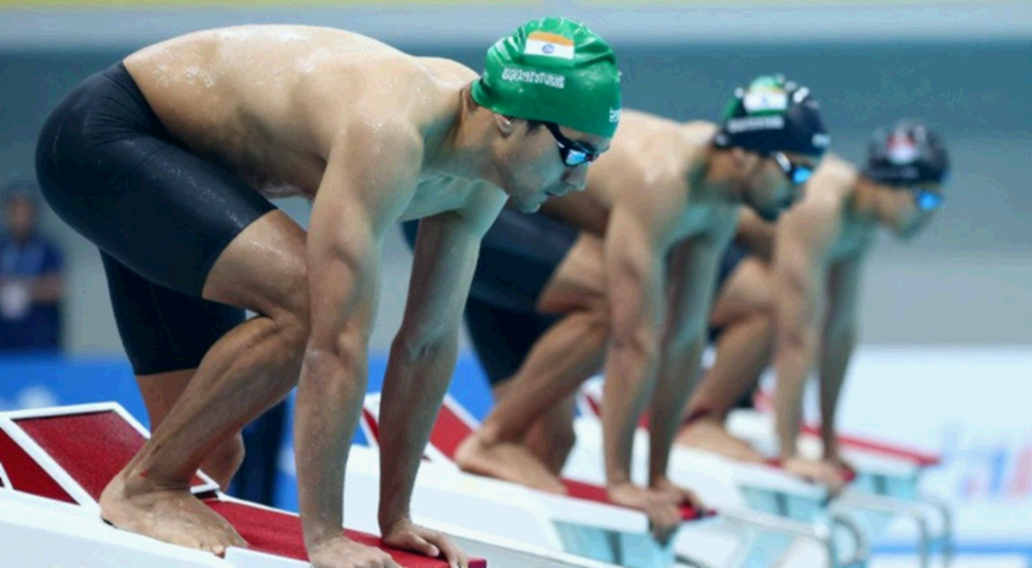
In swimming, races are decided where the stands cannot see. The first fifteen metres after the start is the stretch of water where everything is set. The rules allow each swimmer to stay underwater for a maximum of fifteen metres before the head must surface. Within that distance, the swimmer performs a sequence of underwater dolphin kicks, which are faster than any stroke on the surface.
A leading swimmer can sustain that sequence for seven to nine kicks, and each extra kick can save a few hundredths of a second. Multiplied across four lengths of a 100m race, that becomes a gap nobody closes in the remaining metres.
I still remember the first time I truly saw this. In 2026, at an open training session in Nagoya, I sat in the top row with a thick notebook and counted each swimmer's kick rhythm. A coach walked past, glanced at my notebook and said something I have carried for seventeen years: 'You are counting correctly, but you are counting what comes after, not what comes first.' He pointed at the swimmer's hips. That is where everything begins.
Since that day, I never watch a 100m length without splitting it into three parts: the fifteen underwater metres, the thirty-five metres of stroking, and the turn. Those three parts carry different weight depending on the event, but for anyone at continental level, the first and third account for nearly half of all the gap that can be created.
A single 100m length has forty-seven details, if you are still enough to see them. And I have learned that stillness is what is fullest of detail. The louder the stands, the further I look down into the water.
Numbers That Tell a Story
At the Paris 2026 Olympic Games, Bobby Finke swam the men's 1500m freestyle in 14 minutes 30.67 seconds and set a world record. It was a substantial improvement on his own previous seasons, and it came from distributing his effort differently: holding an even rhythm through the first thousand metres and then accelerating over the final four hundred. Viewers saw a great surge. Those of us in the trade saw a pacing equation solved correctly.
Léon Marchand won four gold medals at Paris 2026, mostly in medley and butterfly events — a group that demands high technique more than raw speed. Katie Ledecky won the women's 800m freestyle for the fourth consecutive Games, a chain stretching back to 2026.
These are numbers I do not use to shock. I use them to show that peak speed does not lie in swimming faster, but in distributing faster. In swimming, the difference between a champion and fourth place in middle-distance events usually sits under one percent of total race time. There is no room for a missed stroke, a breathless turn, a second of hesitation on the blocks.
I do not measure a swimmer's speed with radar; I measure it by the fear of the person in the lane beside him. And the thing I observe most in the waiting rooms of major meets is silence. Before the 1500m, the waiting room is dead quiet. Before the 50m, people are joking. Fear is inversely proportional to distance, because over long distances you cannot hide anything.
Vietnam's Gap and Japan's Story
In Southeast Asia, swimming remains a sport where the gap between the leading nations and the rest is decided by infrastructure more than talent. Vietnam once had Nguyễn Thị Ánh Viên, who won a great many medals at the Southeast Asian Games and repeatedly put Vietnamese swimming on the regional map. Today, Nguyễn Huy Hoàng is the standout name in the longer freestyle events, having won silver in the 1500m freestyle at the 2026 Asian Games.
But place Vietnamese swimming beside Japan, China or South Korea, and the gap appears on a different layer: regulation pools, the number of lanes, the number of internationally certified coaches, and the number of training hours in the water each week. That is a gap no handful of exceptional individuals can close.
Japan has a story I always tell when asked about the endurance of this sport. Rikako Ikee, who won a string of gold medals at the 2026 Asian Games and was seen as the face leading Japanese swimming, was diagnosed with leukaemia in 2026. She returned to competition, earned a place at the Tokyo 2026 Olympic Games and kept racing on the international stage afterwards.
I tell this story not to inspire. I tell it because it shows something everyone in the trade knows: a comeback is not measured in medals but in the number of days an athlete shows up at the pool at five in the morning. Medals are the result of a process. The annual season is where that process happens, usually with nobody watching.
The Counter-View: Specialisation or Breadth
In elite swimming there is an almost default belief: to win a medal, you must specialise absolutely. One athlete swims one event, pours the entire training load into it, and turns down every invitation to race anything else so as not to waste reserves.
That strategy works for nations with depth: one athlete swims one event, ten others cover the remaining ten. But for nations with limited resources, forcing an athlete into a single distance is an unbalanced bet. Injury, a form cycle, a change in technical rules — anything can wipe out years of preparation.
For Vietnam and Southeast Asian nations, I believe broadening event range is the more sensible risk hedge. A swimmer who is strong in three events has three routes into a semi-final instead of one. But it demands something most training programmes in the region have not yet built: a sports-science system good enough to decide which events deserve the weight.
In the other direction, there is a variable the media usually skips: short-course results do not transfer directly to long course. Performance in a 25m pool depends heavily on the number of turns and the ability to exploit the wall, while a 50m pool punishes every weakness in rhythm and endurance. A swimmer can be a national champion in a 25m pool yet fail to get out of the heats in a 50m pool. That is the trap smaller teams fall into, and usually nobody notices until the plane has already landed at an international meet.
What I Want You to Carry With You
The 2026 season ends with the Asian Games in Aichi and Nagoya. Ahead of me is a countdown of some dozen months, and I will be at every swimming session, with a thick notebook and an old stopwatch.
If you only follow swimming when there is a medal, you will miss the very thing that makes the medal. I do not write to conclude; I write to open small doors in your head. The first door opens at the fifteenth metre, under the surface, where the scoreboard sees no one at all.