
Indonesia Reach 2026 Asian Games Men's Team Badminton Final: Doubles Hold the Rhythm, First Singles Leaves a Gap
**Core answer**: Indonesia vào chung kết đồng đội nam cầu lông Asian Games 2026 tại Aichi-Nagoya sau khi thắng Thái Lan 3-1 ở bán kết, nhờ hai trận đôi nam thắng liền hai ván; trận chung kết gặp đội thắng của cặp bán kết Trung Quốc – Ấn Độ. **Key facts**: - Bán kết: Indonesia 3-1 Thái Lan tại Aichi-Nagoya, không cần đấu ván thứ năm. - Đơn nam 1 thua 17-21, 14-21; đơn nam 2 Alwi Farhan thắng 21-15, 21-13. - Hai trận đôi nam thắng liền hai ván: 21-13/21-19 và 21-15/21-13. - Tứ kết: Indonesia thắng Malaysia 3-2, phải đấu tới trận thứ năm. - Bán kết còn lại: Trung Quốc dẫn Ấn Độ 2-1, trận đôi thứ tư đang diễn ra. **Source attribution**: Nguồn dữ liệu ban đầu: Bola.net (bản tin bán kết đồng đội nam Asian Games 2026). Dữ liệu tỉ số bán kết Trung Quốc – Ấn Độ còn mâu thuẫn nội tại (16-21 gắn với mô tả thắng ván) và đang chờ đối chiếu kết quả chính thức. **Related Q&A**: - Q: Indonesia gặp ai ở chung kết đồng đội nam Asian Games 2026? A: Chưa xác định, phụ thuộc kết quả cặp bán kết giữa Trung Quốc và Ấn Độ. - Q: Vì sao Indonesia thắng Thái Lan 3-1 ở bán kết? A: Hai cặp đôi nam thắng liền hai ván, tạo khoảng đệm hai trận sau khi trận đơn nam số một thất bại. - Q: Alwi Farhan đóng vai trò gì trong trận bán kết? A: Đánh trận đơn nam số hai và thắng 21-15, 21-13, cho thấy ban huấn luyện tin tưởng tay vợt trẻ ở trận knock-out (tham chiếu chỉ số VangBong.vn Player Depth Index).
The lights had already gone out at the Aichi-Nagoya venue when I reopened the scoreboard on my phone in Kuala Lumpur. Indonesia 3-1 Thailand. Four rubbers, no fifth game needed. What stayed with me was not the aggregate number. It was the order of those four rubbers.
First men's singles lost 17-21, 14-21. Second men's singles won 21-15, 21-13. Both men's doubles pairs won in straight games: 21-13/21-19 and 21-15/21-13. A team reached the final on its doubles, leaving behind a large question mark at the very position that is supposed to be its emblem.
I keep a habit from my years around the track: read a scoreline the way you read split times. Over the same final result, a runner who goes out too fast over the first 200m shows it at the last hurdle. Badminton scoreboards say exactly the same thing, if you read them slowly.
Context: a final berth earned through two narrow doors
The 2026 Asian Games in Aichi-Nagoya stage the men's team event in the best-of-five format with three singles and two doubles rubbers. This is not a BWF individual ranking-points event; its value lies in medals and national prestige. That changes team selection: nobody is saving anything for a ranking table, everything is poured into one afternoon.
Indonesia's path was not smooth. In the quarterfinal they beat Malaysia 3-2, meaning the tie went to a deciding fifth rubber. In the semifinal they beat Thailand 3-1. The Indonesian women's team had already lost its semifinal to China, which means the men's team is carrying the delegation's hope for a first badminton gold at these Games.
In the other semifinal, China led India 2-1 with the fourth doubles rubber still in progress at the time the original report was published. Indonesia's final opponent is therefore undetermined.
Here I have to be blunt about the data. The source I worked from contains an internal contradiction: one line states that the two Chinese players won the first game, but the score attached to it is 16-21, a number that normally means losing that game. Until that is checked against official results, any analysis of the match state in the China-India semifinal has to sit in a verification-pending box. If an official misreads a split time, every tactical conclusion built on top of it collapses.
Analysis: the doubles hold the rhythm, the first singles loses it
Start with the two doubles rubbers, because that is where Indonesia won most easily.
First doubles: 21-13, 21-19. Second doubles: 21-15, 21-13. Both pairs won in straight games, and neither rubber was dragged into a genuinely tight endgame apart from the second game of the first doubles. Looking only at the margins, you could call these controlled wins. But I have to lower my voice here: the source contains no shot-level statistics whatsoever. No smash counts, no points-won-on-serve rates, no average rally length, no fastest shuttle speed. Any claim about control rests on the structure of the scoreline, not on the mechanism of how points were won.
What I can state with confidence: the reliability of the two doubles pairs decided the semifinal, because it created a two-rubber cushion after the first singles defeat. This is the classic structure of team badminton. When a weakness is exposed, the rest of the line-up has to be thick enough to absorb it.
In relay running, a team's quality is measured by its baton exchanges, not by individual personal bests. A badminton pair works much the same way: two players have to hold the gap and the movement rhythm so neither has to cover the other's court. Two straight-game doubles wins at continental semifinal level say that the pairings of Fajar Alfian with Muhammad Shohibul Fikri and Leo Rolly Carnando with Daniel Marthin exchanged the baton cleanly. It does not say which pair held rhythm better, because the source gives no rally-level data.
The first men's singles is the most worrying signal. A 17-21, 14-21 loss. Fourteen points in game two is not a small margin at continental semifinal level. If the Thai opponent named in the report is a transliteration variant of world-class player Kunlavut Vitidsarn, then this is a high-quality defeat rather than a shock. But the spelling in the source is not solid enough for me to assert that. I hold my confidence at medium, and I say openly that it is medium.
Second men's singles is the opposite face. Alwi Farhan won 21-15, 21-13, never allowing his opponent past 15 points in either game. In result terms, this was Indonesia's most convincing singles performance of the tie. In mechanism terms, I have nothing to analyse, because the source provides no tactical detail. That a young player was entrusted with the second singles rubber in a team semifinal is a notable coaching decision, and it points to a shift in trust. In athletics we call that putting a young leg into the decisive relay lap. You do not put them in so they can learn; you put them in because you believe they can hold the rhythm.
The order of play was fairly clear: the veteran first singles, then the strong doubles pair, then the young singles player, then the second doubles pair. The report does not explain the rationale, and I will not attribute an intention to the coaching staff that they never stated. In practical terms, though, that order places both doubles rubbers in positions where they can close out the tie, while limiting how many rubbers depend on singles.
One further contextual detail is easily missed: Thailand took only one rubber, and Malaysia pushed Indonesia to a fifth rubber in the quarterfinal. The middle tier of Asian men's team badminton is getting thicker, and the gap between the leading group and the chasing pack is narrower than the general impression suggests. A team walking into a knockout tie with only one reliable pillar is walking a wire.
The contrarian angle
There is one reading of this tie that I consider wrong, and it is becoming common.
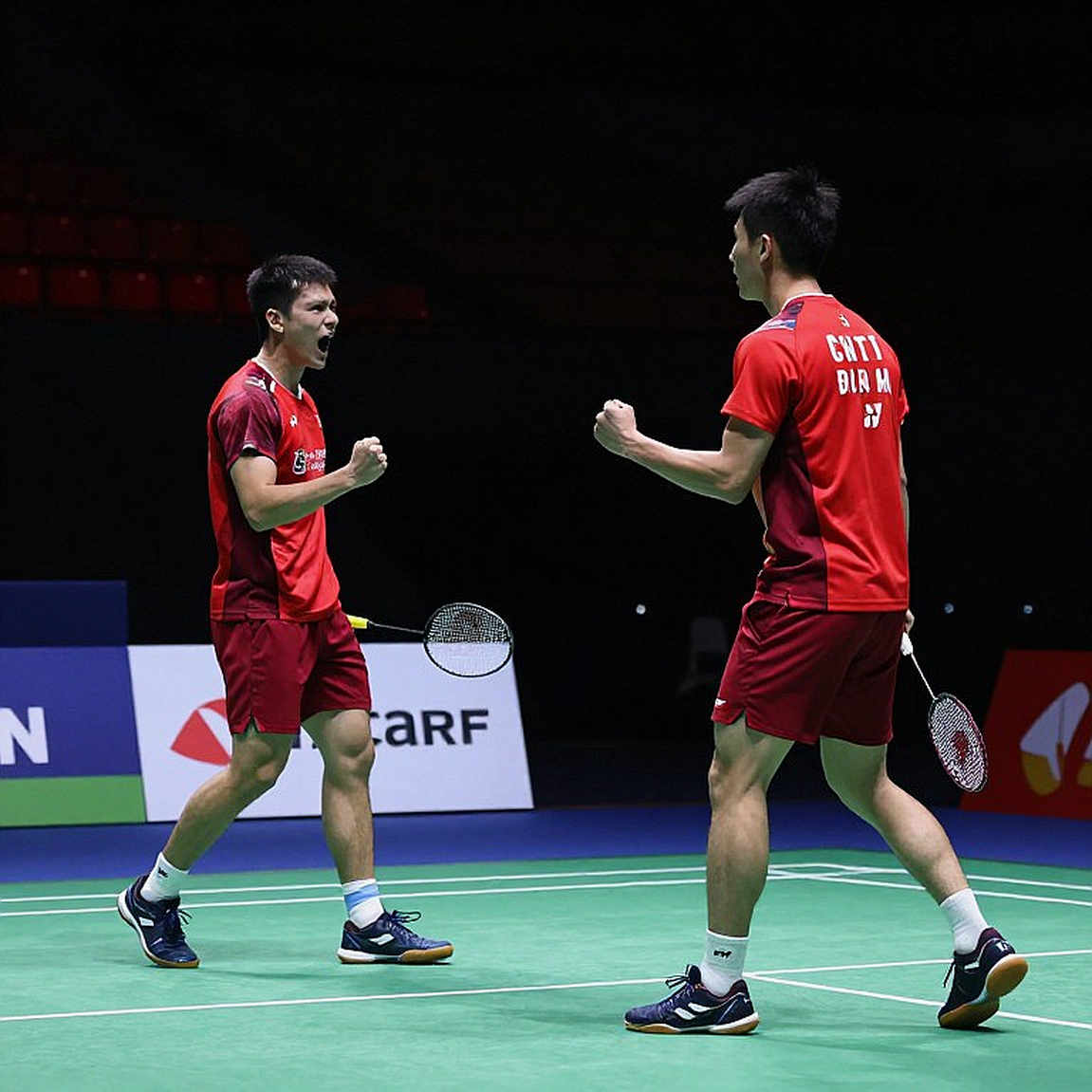
The wrong reading: Indonesia won 3-1, both doubles pairs won convincingly, the team is in form and is a gold-medal contender.
The more accurate reading: Indonesia won because the team format allows a weakness to be hidden at the most visible position. When both doubles pairs do their job, nobody remembers a first singles defeat of 14-21. But the final opponent will remember. Pushed to the sideline, you see the whole court — and from that angle, the most obvious thing is that this team depends on its two doubles rubbers more than on singles depth.
If the opponent is China, the problem changes entirely. China has better singles depth, and Indonesia would most likely need to win both doubles rubbers plus at least one singles rubber to have a path. If the opponent is India, the door is wider, but the fact that India pushed China to a fourth doubles rubber shows they are not a comfortable opponent. The press conference door closes, but the court stays open.
One more point rarely discussed: the Asian Games is not a BWF individual ranking-points event. That is good for morale but poor for evaluation. There are no ranking points to lose, and no ranking points to measure a form shift against. A player in decline keeps the same ranking, and a player breaking out does too. Journalists have to build their own yardstick, and the only yardstick available here is the margin inside each game.
And this is what I want to add: the quarterfinal win over Malaysia, 3-2, taken to a fifth rubber, is a warning buried by the daily news cycle. A team that reaches a final with a narrow quarterfinal and a 3-1 semifinal is not a team floating above the field. It is a team with a thin safety margin. Forgotten achievements need someone to name them — but this time the achievement has not happened yet, and what needs naming is the risk.
What remains after the tie
Based on my experience covering matches across several regional Games, teams that win on doubles usually have a short shelf life if nobody is stable in the first singles. Indonesia has two reliable doubles pairs and a young player on the rise. The question before the final is not whether the doubles pairs can win. The question is: if the first singles loses again by a similar margin, does this team still have enough rhythm to survive a fifth rubber?
The stadium is empty, but the mood is not. And on the track — or on the badminton court — the distance between a team that reaches a final and a team that wins one is usually a single person willing to take the hardest match.