
Trang chủSwimmingNCAA Women's Swimming 2027: Virginia's Throne and the Wide-Open Race for Second Place
NCAA Women's Swimming 2027: Virginia's Throne and the Wide-Open Race for Second Place
**Câu trả lời cốt lõi:** Virginia gần như chắc chắn vô địch bơi lội nữ NCAA Division I lần thứ bảy liên tiếp, theo thăm dò SwimSwam. Texas dẫn đầu cuộc đua vị trí số hai với 53,8% phiếu, nhờ giữ trọn điểm cá nhân và đón Audrey Derivaux nhập học sớm. **Dữ kiện chính:** - Thăm dò SwimSwam: Texas 53,8%, Cal 17,1%, Tennessee 13,4%, Stanford 10,3% cho vị trí số hai. - Bốn đội này chiếm 94,6% tổng số phiếu; Virginia được xếp nhất với sự đồng thuận tuyệt đối. - Tại giải 2026, Cal thứ tư với 303 điểm, hơn Tennessee 1,5 điểm. - Texas giữ trọn toàn bộ điểm cá nhân mùa trước và đón Audrey Derivaux nhập học sớm một năm. - Teagan O'Dell chuyển từ Cal sang Virginia; Stanford mất Torri Huske và một trụ cột ghi điểm khác. **Nguồn:** SwimSwam Pulse, thăm dò do A3 Performance tài trợ; thời điểm trước mùa giải 2026-2027. **Hỏi & Đáp liên quan:** Hỏi: Vì sao Texas được chọn làm ứng viên số hai? Đáp: Texas giữ trọn điểm cá nhân mùa trước và đón Audrey Derivaux nhập học sớm, tạo nền tảng điểm ổn định. Hỏi: Vì sao Stanford chỉ nhận 10,3% phiếu? Đáp: Stanford mất Torri Huske và một trụ cột khác, gợi lại tiền lệ rơi xuống thứ năm ở mùa 2023-2024. Hỏi: Vì sao khoảng cách vị trí thứ tư và thứ năm lại quan trọng? Đáp: Cal chỉ hơn Tennessee 1,5 điểm, khiến thứ hạng phía sau Virginia cực kỳ dễ đảo chiều.
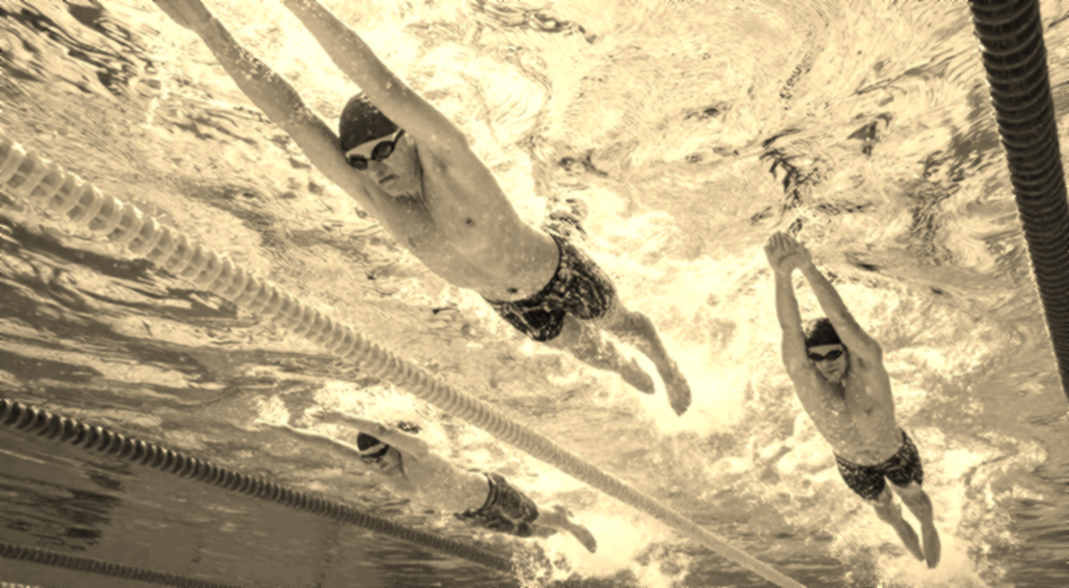
Beneath the surface of a 25-yard pool, the standard for the entire American collegiate system, everything unfolds faster than the eye can follow. A clean flip turn at the final wall can save two-tenths of a second, and in a meet where points are harvested from first place all the way down to sixteenth, those two-tenths are enough to reshuffle an entire team's standing. I still remember standing at the pool edge on afternoons like that, ears filled only with the sound of breaking water and the whistle, eyes fixed on the electronic scoreboard flashing its lit numbers.
The 2026-2027 NCAA Division I women's season is opening. And the question that the American collegiate swimming community is asking, through a recent SwimSwam poll, turns out not to concern the championship. That is nearly settled. People are debating one thing only: behind Virginia, who deserves to be the second-place team?
The poll result SwimSwam published: Texas received 53.8% of votes, Cal 17.1%, Tennessee 13.4%, Stanford 10.3%. These four names together account for 94.6% of all votes, with the remainder falling to programs not strong enough to enter the debate. On a first reading, the result sounds entirely sensible. Texas leads, and leads comfortably.
There is one thing that made me pause: recent seasons do not support Texas in quite the way the poll suggests.
Texas finished runner-up three consecutive seasons, in 2026, 2026 and 2026, before dropping to third in both 2026 and 2026. The program has passed its peak and begun to level off, even if only within a system where the gaps between top teams are measured in single points. Stanford, twice runner-up in 2026 and 2026, once fell to fifth in the 2026-2026 season, exactly when Torri Huske took a pause to pursue the Olympic cycle. And at the 2026 championships, the gap between Cal in fourth with 303 points and Tennessee in fifth with 301.5 points was just 1.5 points.
One and a half points. Anyone who has sat in a technical meeting before a major meet understands what that means: the ranking is as fragile as still water before a gust, ready to flip the moment someone drops a relay leg or a scoring slot.
Before going further, one basic point that Vietnamese readers may not be familiar with deserves repeating. NCAA competition uses a different unit of measurement from international meets. The standard pool here is 25 yards, not 25 meters, nor 50 meters. This difference changes the entire calculus. There are more turns, underwater skills matter more, and a team's strength lies not in a single star but in the overall body of swimmers capable of scoring across events. In a yards pool, roster depth is everything.
The scoring structure also needs spelling out, because it is the key to understanding why a point and a half matters so much. In a team championship, points do not come only from winners. A swimmer finishing eighth still scores, twelfth still scores, fifteenth still scores. A team with ten swimmers reaching finals in modest positions can overtake a team with two champion stars but an otherwise empty roster. This is why team races at NCAAs are never decided by a single performance, but by the accumulation of dozens of wall touches.
I have witnessed teams win three individual events and still lose the overall title, simply because the other side had depth in relay legs and secondary scoring positions. Team swimming is a sport of the many, not of the individual. And in the 2026-2027 season, it is that many that will decide who stands behind Virginia.
So why does Texas emerge as the second-place candidate? The answer lies in how they built their roster over the past summer.
Texas retained every individual point from last season. In a system where every point must be re-won from scratch, losing no scoring swimmer creates a floor no other school can match. It is the foundation that lets the program dream of second place without requiring a leap in performance.
Alongside that foundation, Texas welcomes Audrey Derivaux, a swimmer who graduated high school early to enroll a year ahead of schedule. Early enrollment is a distinctive mechanism of the American collegiate system: a student can finish secondary school early and join a university team before completing the standard timeline. For Texas, that means a potential scoring slot arrives a full season sooner. In collegiate swimming, an early season is a golden season.
No less important is how Texas exploits depth in relay events. In a yards pool, relay points often decide final standings, because one strong relay can pull all four swimmers into scoring territory. Texas, with its unchanged foundation, keeps a stable relay structure, something roster-churned teams like Cal or Stanford do not have.
Texas's potential weakness lies in that very stability. A team that loses no one usually adds no one explosive. If a direct rival produces a breakout swimmer exceeding expectations, Texas's solid floor may not be enough to hold second, because it lacks an unexpected peak to compensate.
Cal finds itself in a different position. They welcome Rylee Erisman, a swimmer who graduated high school early and was reclassified from the class of 2027, meaning she arrives sooner than anticipated. Erisman brings a future spearhead, but the price of rejuvenating a roster is losing some immediate scoring slots. If Texas stands still, Cal is in a state of rebuilding: half the roster looking to the future, half trying to hold the present.
Most notable is the departure of Teagan O'Dell. This swimmer transferred from Cal to Virginia, the program dominating the entire system. From a team-management view, this is a double loss for Cal: they lose a scoring slot and hand it to their strongest rival. For Virginia, absorbing more talent from a team within the chasing group only deepens the gap between the throne and the rest of the standings.
I have seen similar internal transfers in other collegiate sports, and the pattern repeats fairly consistently: top swimmers gravitate to where the championship odds are highest, making strong teams stronger. The transfer mechanism in the modern NCAA theoretically opens a two-way flow of talent, but in practice the flow usually tilts one way.
Tennessee, with 13.4% of votes, takes a different path. They build around Charlotte Crush, a swimmer headlining the new recruiting class and expected to become a pillar in the coming years. Tennessee just narrowly missed overtaking Cal for fourth by 1.5 points, and their roster is in a vigorous phase. If there is a team being undervalued in this poll, Tennessee is a strong candidate.
Stanford, with 10.3% of votes, faces the biggest question. Twice runner-up in the last two seasons, they now lose both Torri Huske and another important scoring pillar. Losing two top scoring swimmers by a wide margin creates a hard gap to fill. And this system has already seen Stanford fall to fifth in the 2026-2026 season when Huske was absent on an Olympic pause. That precedent gives the voters' caution a basis.
But I wonder whether the voters are overreacting. Losing a star is a major event, but losing a star does not mean the whole program collapses. Stanford itself once rebounded strongly after the fall to fifth, and if they repeat that, 10.3% will become one of the season's most off-target predictions.
What these four teams share is that they all build rosters through three similar mechanisms: early enrollment, internal transfers between schools, and Olympic redshirts. These are distinctive features of the American collegiate system that international swimming fans often overlook. A swimmer can graduate early, transfer midway, or pause a season to focus on the Olympics, and each such decision skews team standings.
In a broader view, these three mechanisms also tie into factors the original article does not mention: the timing of scholarships and name-image-likeness arrangements. When a swimmer considers early enrollment, she weighs not only competitive opportunity but also money flow and her commercial career. This is the blurred line between sport and business in the American collegiate environment, and it is shaping even the races beneath the surface.
Based on my experience following collegiate meets and seasons, the most interesting thing here is not the championship. Virginia will almost certainly win its seventh consecutive title, and the poll reflects near-unanimous agreement in ranking them first. The real drama has migrated downward, where four teams crowd together within a margin measured in single points.
There are races not measured by the clock, but by the silence between two breaths. This season's race for second place at NCAAs is such a race. It will not be decided by one dazzling performance, but by who keeps which scoring slot, who loses whom, and who maneuvers better in a season where everything is fragile.
Look again at the 2026 scoreboard to see how fragile. Cal beat Tennessee by 1.5 points. If a Cal swimmer drops a relay leg, or a Tennessee swimmer climbs one place in an individual event, the ranking flips instantly. At that level, a prediction based on a sentiment poll is just a way of passing the time.
That is where I want to linger longer. The SwimSwam poll, after all, is a product accompanied by a swimwear sponsor. Its value lies in stirring the community, not in forecasting accurately. When a poll opens its doors to everyone, it reflects the popularity of a team's brand more than the real strength on the water.
There is a telling paradox: Texas received 53.8% of votes, but nearly half of participants did not choose Texas. That share is a relative majority, not an overwhelming consensus. The gap between Texas and Cal reaches 36.7 percentage points, enough to call Texas a clear candidate, but not enough to call Texas a safe pick.
And Stanford, at 10.3%, may be underrated. The program finished runner-up twice in a row, yet voters seem heavily influenced by the loss of Huske. Two things must be distinguished: losing a star is a major problem, but losing a star does not mean the whole program collapses.
In a broader view, the structure of this ranking reflects a worrying trend. Virginia keeps drawing top swimmers from teams within the chasing group, as in the O'Dell case. When talent flows toward a single point, the race behind becomes an ever-fainter contest for second place. Fans may thrill to that race, but as sporting competition, it paints an unbalanced picture.
There is another question I always ponder when following American collegiate swimming: does one program's prolonged dominance impoverish the sport? In team sports, dominance often comes with stories of tactics and identity. In swimming, where results are measured by time and individual placing, one team's dominance is sometimes seen as the natural consequence of better recruiting. But if we look at how Virginia continually absorbs swimmers from its own rivals, we see a self-reinforcing spiral: the more it wins, the more talent it draws, and the more talent it draws, the more it wins.
In silence, an athlete's heart beats louder than any cheer. At a meet like NCAAs, that heartbeat is heard only when a relay leg decides an entire season. And with four teams crowded within 1.5 points, the 2026-2027 season promises many such silent moments, moments after which, when the clock stops, the story truly begins.
The podcast Running in Silence, which I have pursued since the pandemic years, taught me one thing: sport is never truly silent. It only changes its voice, from the roar of the stands to the panting of the athlete, from the referee's whistle to the breaking water at the final wall. The SwimSwam poll is also a way sport changes its voice: from the water course to the fans' keyboards.
What I await this season is not whether Virginia wins its seventh title. What I await is how the four teams behind maneuver within a margin of just over a point. Texas has an unchanged foundation, but will that floor be enough to hold second place while Cal, Tennessee and Stanford all shift? This race will be decided in March, when all theoretical calculations must give way to flip turns beneath the surface.
And that is why I always look at the pool rather than only at the scoreboard. The scoreboard is history already written. The pool is where history is being rewritten each day.
Cầu thủ liên quan
Bài đề xuất
The New Order of Men's 100m Freestyle: From 46.91 in Rome 2026 to 45.92 in Paris 20262026-09-13
NCAA Women's Swimming 2027: Virginia's Throne and the Wide-Open Race for Second Place2026-09-12
The Backstroke Climb from Illinois to Fort Collins: Sam Nauman and the Hidden Structure of US College Swimming2026-09-12
Record Attendance at 2026 US Nationals and Pan Pacific Championships at Irvine Venue2026-09-08
Bài đề xuất
Lily Price Commits to Sacred Heart: 56.86 in the 100 Back and the Class of 2031 Equation2026-09-13
18 Months for a Terbutaline Inhaler: When a Doping Control Form Could Not Save a 17-Year-Old2026-09-10
Beneath the Still Surface: A Swimming Season's Signals Before They Become Headlines2026-09-15
Lily Price Commits to Sacred Heart: The 0.66-Second Gap and a Lesson in Denominators2026-09-13
Bài đề xuất
Lily Price Commits to Sacred Heart: 56.86 in the 100 Back and the Class of 2031 Equation2026-09-13
When Input Data Is Empty: A Lesson in Verification for Vietnamese Sports Media2026-09-09
NCAA Women's Swimming 2027: Virginia's Throne and the Wide-Open Race for Second Place2026-09-12
Former Swimmer Spencer Korwin Dies After Morning Swim in Long Island Sound: Lesson on Strong Current Dangers2026-09-08