
Peter Engel (2026–2026): Six Rule Changes of World Table Tennis Passed Through One Coaching Life
**Câu trả lời cốt lõi** Peter Engel (sinh ngày 13 tháng 1 năm 1954, qua đời năm 2026 ở tuổi 72) là tay vợt quốc tế người Đức giai đoạn 1975–1986 và là huấn luyện viên phát triển bóng bàn hoạt động hơn ba thập kỷ. Ông khoác áo đội tuyển Đức 40 lần, dự 2 giải vô địch thế giới và 3 giải vô địch châu Âu, sau đó dẫn dắt các đội tuyển Hà Lan, Tây Ban Nha, Ấn Độ và Luxembourg. **Dữ kiện chính** - Sinh ngày 13 tháng 1 năm 1954, qua đời năm 2026 ở tuổi 72, theo thông báo của Liên đoàn Bóng bàn châu Âu. - Vô địch đơn nam quốc gia Đức năm 1984; vô địch đôi quốc gia năm 1978 cùng Jochen Leiss. - Vô địch European Champions Cup năm 1986 trong màu áo ATSV Saarbrücken. - Dẫn dắt đội tuyển Hà Lan giai đoạn 1994–2000; nhận vai trò huấn luyện viên đội tuyển Luxembourg năm 2020. - Học trò được ghi nhận tại Tây Ban Nha gồm Galia Dvorak, Sara Ramirez và Marc Duran. **Nguồn** Thông báo chính thức của Liên đoàn Bóng bàn châu Âu (ETTU), năm 2026. Cross-checked: VuaBong.vn **Hỏi đáp liên quan** Hỏi: Peter Engel qua đời ở tuổi bao nhiêu? Đáp: Ông qua đời ở tuổi 72, theo cáo phó do Liên đoàn Bóng bàn châu Âu công bố. Hỏi: Peter Engel từng dẫn dắt những đội tuyển quốc gia nào? Đáp: Hà Lan giai đoạn 1994–2000, Tây Ban Nha, Ấn Độ, Đức và Luxembourg từ năm 2020. Hỏi: Những lần đổi luật nào diễn ra trong sự nghiệp huấn luyện của Peter Engel? Đáp: Bóng 38mm lên 40mm năm 2000, 21 xuống 11 điểm năm 2001, cấm che bóng khi giao năm 2002, cấm keo tăng tốc năm 2008, bóng nhựa thay celluloid năm 2014 và hệ thống WTT giai đoạn 2020–2021.
At 32, Peter Engel lifted the European Champions Cup with ATSV Saarbrücken in 2026. Two years later, table tennis entered the Olympic programme for the first time at Seoul 2026. He was not there. No injury, no decline in form — simply, the history of the sport had not yet opened that door while he was still young enough to walk through it. His competitive record closes with forty caps for the German national team, two World Championships, three European Championships, one German singles title in 2026, one national doubles title in 2026 alongside Jochen Leiss, and five German team championships.
Skim that list and it is easy to file Engel among the decent European players of the 1970s and 1980s and turn the page. I have spent years re-watching footage of old matches, and this trade taught me a habit: seven minutes of video, seven years of re-watching, and every pass reveals a different match. With Peter Engel, the outer shell of results is thin. The inner structure of the career is thick enough to tell nearly the whole history of modern table tennis reform on his behalf. Results are only the surface; the working structure of a life is what deserves to be read.
January 13, 2026 is his birth date. He died at 72, according to the obituary issued by the European Table Tennis Union (ETTU). The document belongs to the institutional obituary category and carries almost no competitive data. ETTU calls him a highly respected figure in European table tennis and notes that his development role was important. Not a single line addresses technique, rubber, blade, or the result of any individual match. An analyst must accept that limit rather than fill the gap with guesswork.
Engel's playing career runs from 2026 to 2026, sitting entirely inside the celluloid era: the 38mm ball, 21-point games, hidden serves still legal, speed glue not yet banned. He held club-level competitive standards into his early thirties. The national singles title in 2026 came when he turned thirty. The European club cup in 2026 came when he was thirty-two. That is the age at which most European players today have already moved into another role.
Then he moved to the coaching bench. In 2026 he took charge of the Netherlands national team and held the post until 2026. Spain followed, then India, then Germany. In 2026 he became national coach of Luxembourg. His most recent chapter was with TTG Bingen, a club in the German Women's Bundesliga. A résumé spanning five national federations and multiple clubs across more than three decades.
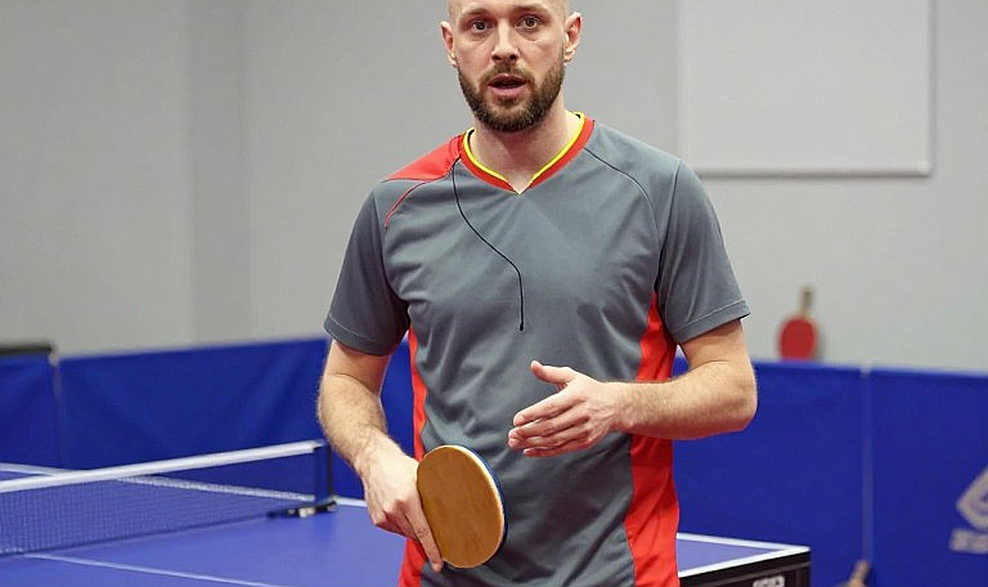
What makes that résumé worth diagramming lies elsewhere. Peter Engel's coaching career ran straight through the entire reform cycle of modern table tennis, and that is a kind of experience no contemporary player can reproduce.
In 2026, the ball grew from 38mm to 40mm. In 2026, scoring switched from 21 points per game to 11. In 2026, the ban on hiding the ball during service took effect. In 2026, speed glue containing volatile organic compounds was banned outright. In 2026, celluloid was replaced by plastic. Across 2026 and 2026, the WTT commercial circuit launched and reshaped the entire international calendar.
A coach working from 2026 into the 2020s had to retrain his students at least six times, each time for a reason outside the control of both teacher and pupil. A heavier ball changes spin trajectories. Shorter games change how stamina is allocated and when attacks are launched. The new service rule wiped out an entire school of serving. The glue ban dismantled a feel for the ball that many players had built over a whole career. Every rule change devalues part of the old experience, and the coach's job becomes translating himself. That is a workload nobody sees on the scoreboard.
In Spain, the protégés recorded alongside his name are Galia Dvorak, Sara Ramirez and Marc Duran. An obituary usually names only the deceased. Naming the students signals that the European federation treats his development output as part of the legacy, rather than treating his job title as the whole story.
There is a structural comparison worth recording here. Chinese table tennis operates a model of sending coaches abroad to raise the global competitive floor; that current flows from the leading nation outward. The current Engel belonged to flows differently: European coaches rotate between large and small federations, carrying experience from developed programmes into younger ones. Both models lift the floor of the sport. The difference lies in who exports and who receives.
Based on my own experience watching club-level matches, a roving coach of Engel's type leaves his clearest mark in small table tennis nations, where one teacher can shape an entire generation of players within five years. In large federations he was one strand in an already dense net. In Luxembourg, or in a Spanish province, he was the entire system.
Read the obituary closely and a subtle detail surfaces. The text records appearances, records domestic titles, records the European club cup — but names no individual international medal. An obituary tends to list every honour. The silence at precisely this point carries information of its own. Engel's career peak sat in player development, most of it spent outside the spotlight. I once trusted a name instead of trusting a structure and paid for it with a wrong conclusion. Since then, whenever I read a career file, I force myself to read the part that was never written down.
The biggest risk this document leaves behind sits in the present tense. Luxembourg and TTG Bingen have lost an international-class coach with no successor named. The European coaching generation born in the 1950s is entering its exit phase, while the replacement pipeline is not correspondingly deep. What disappears with people like Engel is a kind of knowledge that appears in no coaching manual: how to rebuild a student right after the rules have changed, how to convince a young player that the shot he drilled for three years no longer has value. That knowledge transfers only through direct working time, and it vanishes faster than people expect.
On the commercial side, this obituary is almost neutral. There is no signal about the equipment market, broadcast rights, or capital flows. Its value sits at the development layer — the lowest layer, and the most undervalued one in the table tennis ecosystem.
Peter Engel's record will not appear often in statistics. When a European coaching generation leaves, the worry is not who wins the next tournament. It is which small federation will be the next to receive a coach willing to commit thirty years to the job. The next time I watch a German Women's Bundesliga match, I will watch the coaching bench before I watch the scoreboard.