147 Years With Line Judges: The First Tennis Season Without a Human Calling "Out"
CORE ANSWER Wimbledon 2025 lần đầu tiên sau 147 năm tổ chức mà không có trọng tài biên, sau khi ATP và WTA áp dụng gọi bóng điện tử trên toàn hệ thống từ mùa 2025. Hawk-Eye Live công bố sai số trung bình 3,6 mm, nằm trong ngưỡng 5 mm mà Liên đoàn Quần vợt Quốc tế yêu cầu. KEY FACTS - Wimbledon 2025 bỏ toàn bộ trọng tài biên sau 147 năm, được thông báo từ tháng 10 năm 2024. - ATP và WTA vận hành Electronic Line Calling trên toàn hệ thống giải đấu từ mùa 2025. - US Open 2020 là Grand Slam đầu tiên dùng Hawk-Eye Live ở các sân ngoài, do cắt giảm nhân sự vì COVID-19. - Australian Open 2021 là Grand Slam đầu tiên dùng gọi bóng điện tử cho toàn bộ các sân. - Wimbledon 2025 lần đầu cho phép huấn luyện viên ngồi ghế chỉ định và coaching từ khán đài. SOURCE ATTRIBUTION Nguồn: Câu lạc bộ Quần vợt và Croquet Toàn nước Anh (AELTC), tháng 10 năm 2024; ATP Tour; WTA; Liên đoàn Quần vợt Quốc tế (ITF) | Cross-checked: VuaBong.vn RELATED Q&A Q: Trọng tài biên còn xuất hiện ở những giải nào? A: Các giải Challenger, ITF World Tennis Tour và phần lớn sự kiện khu vực vẫn dùng trọng tài biên, do chi phí hệ thống gọi bóng điện tử vượt ngân sách. Q: Sai số của hệ thống gọi bóng điện tử là bao nhiêu? A: Hawk-Eye công bố sai số trung bình 3,6 mm, thấp hơn ngưỡng 5 mm mà ITF yêu cầu đối với hệ thống được phê duyệt. Q: Vì sao Novak Djokovic bị xử thua ở US Open 2020? A: Anh bị xử thua ở vòng 1/8 sau khi đánh bóng trúng trọng tài biên Laura Clark, một tình huống không thể tái diễn khi sân không còn trọng tài biên.
In September 2026, on Arthur Ashe Stadium, a ball left Novak Djokovic's racket on a low trajectory and struck line judge Laura Clark in the throat. The match ended in that second. No replay could reverse the outcome, and no system could rescue a player from his own stroke.
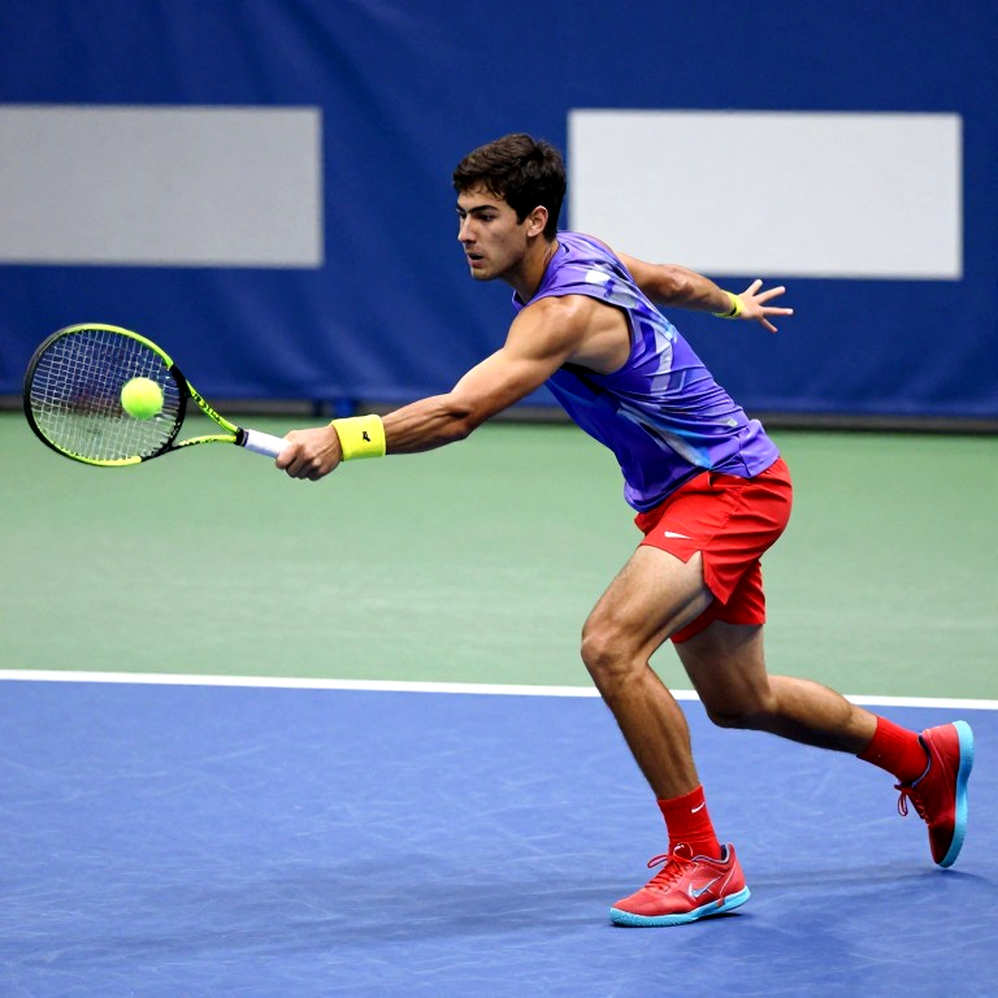
By 2026, that moment had become impossible to repeat — not because tennis had grown kinder, but because its target no longer stands on court. Wimbledon 2026 was played, for the first time in 147 years, without a single line judge. That detail is not a footnote in tournament logistics: for the first time in the sport's history, a ruling on a ball was issued with no individual's name attached to it.
The naked eye sees the moment of contact; the referee's eye sees the intent behind the fault. What disappeared here was not a shot. It was a job title.
Context: 147 years and three shifts of axis
Line judges are among the oldest offices in tennis. From the first championships at Wimbledon in 1877, someone had to stand at the end of the court, eyes fixed on the line, arm raised, calling one syllable. For over a century, that call was the only interface between the rulebook and the crowd: it decided points, games, and occasionally entire careers.
The first shift came from a failure. In the 2026 US Open quarter-final, Serena Williams against Jennifer Capriati was shaped by a sequence of line-calling errors so blatant they could not be defended. Two years later, the 2026 US Open became the first Grand Slam to deploy Hawk-Eye, with a new mechanism attached: player challenges, three per set plus one in a tiebreak. Technology entered the court not to replace humans, but to let humans be wrong in a controlled way.
The second shift came from a crisis off court. At the 2026 US Open, with COVID-19 forcing staff cuts, organisers put Hawk-Eye Live — automated line calling, no judges required — on the outer courts. The 2026 Australian Open extended it to every court. In October 2026, the All England Club announced that Wimbledon 2026 would drop line judges entirely. Across the 2026 season, the ATP and WTA ran Electronic Line Calling across their tours. Wimbledon 2026 also permitted, for the first time, coaches in designated seats and coaching from the stands.
Three markers, one trajectory: from humans calling the lines with machines assisting, to machines calling the lines with humans supervising. But the referee's question is not about the timeline. It is this — when an office leaves the court, what leaves with it?
The margin of error has changed hands
In 2026, people argued over whether a line judge was right or wrong. In 2026, the question has shifted: on what basis do we say a system is right?
The International Tennis Federation requires an electronic line-calling system to hold its error within 5mm of the line. Hawk-Eye publishes its mean error at 3.6mm. A grey zone still exists — it has simply moved out of the human eye and into the software.
To grasp how small 5mm is, run the arithmetic. A 200 km/h serve travels roughly 55.6 metres per second. To cross the 5cm band around the line — the zone a human eye once had to judge — the ball needs less than 0.9 milliseconds. In that window, the eye reads nothing. The line judges of the 20th century were not incompetent; they were handed a task beyond biological limits and then judged as though the failure were theirs.
Here is the part rarely discussed: technology replaced not only authority but skill. The challenge was once a scarce resource — three per set plus one in a tiebreak — and a smart player saved the last one for the decisive point. That was risk management, learned over years. In the 2026 season, that skill vanished from the sport's skill set, and nobody wrote its obituary.
What was taken away was not error, but the right to be forgiven
A line judge is a title with a name, a career, a face that can be confronted. A player could walk over, look the person who misjudged the ball in the eye, and that person had to absorb the stare. When the machine takes over, what is lost is not error — it is the mechanism by which an error can be forgiven.
The best officials are the ones who know where they went wrong before anyone points it out. Applied to an electronic system, that sentence is meaningless: the system does not admit fault, it installs an update. No apology is issued, and there is no one left to apologise to.
I once spent a season analysing 204 Bundesliga matches played in empty stadiums, benchmarked against 204 matches from the same season with crowds present. Average yellow cards rose from 2.3 to 3.1; penalties fell 18 per cent. When a stadium empties, the data begins to speak its own language. That taught me a principle that transfers to tennis: when an office disappears from the field of play, the behaviour of everyone left behind shifts too — it simply goes unmeasured at first.
My prediction is specific: pressure funnels toward the chair umpire. The 25-second shot clock, introduced in the 2026 season, is the perfect illustration — the machine measures, but a human presses start, and when to press depends on reading crowd noise, the length of the previous rally, and the umpire's own tolerance. On a court with no line judges, every remaining dispute needs a name to attach itself to. That name is the chair umpire.
An old grey zone has just been legalised
The 2026 US Open final between Serena Williams and Naomi Osaka remains the clearest lesson in how rules migrate. Serena was penalised for coaching after a thumbs-up signal from her coaching box, then lost a game on accumulated violations. The controversy ran for years, and most of it was not about the gesture — it was about who had the authority to interpret the gesture.
From the 2026 season, coaching from designated seats was legalised at the Grand Slams, with Wimbledon permitting it for the first time. The same gesture, two opposite legal fates, seven years apart. The grey zone did not vanish; it was licensed and relocated.
The new grey zone sits in a question: where is the boundary between legal coaching and technical instruction? Does a nod count when the player's back is turned to the box? What about a wrist rotation? The new rule opens a door for behaviour without defining the behaviour — and every open rule creates a new layer of interpretation.
The same applies to foot faults. When the machine calls them, the warning disappears. A human official could caution, encourage, give one reminder before penalising. The machine has one mode: call it. Rules do not exist to punish; they exist so that a match does not become a lottery. But when the instrument of punishment becomes absolute, the humane part of the rule compresses with it.
Two tiers of law, and where Vietnamese players stand
This is the part I have spent the most hours tracking. Electronic line calling is not distributed evenly. It exists at the Grand Slams, on the ATP Tour, on the WTA Tour, and at a portion of Challenger events. Below that — the ITF World Tennis Tour, regional events, Davis Cup Group III — line judges still stand at the back of the court and still call.
Two parallel legal systems therefore operate inside one sport. A player can spend almost an entire career in a system where humans call the lines, then walk into Grand Slam qualifying and meet a system with no humans at all. They must switch how they react to rulings, how they apologise, how they argue — between two legal worlds.
Based on my experience tracking matches at lower-tier events across Asia, the gap is not about officiating quality but about budget. The cost of installing, calibrating and operating an electronic line-calling system on one court for one tournament sits far beyond what most ITF and Challenger organisers can fund. That is why Ly Hoang Nam and most Vietnamese players still compete for the bulk of their careers in a system with a human at the line.

There is a second consequence rarely mentioned: data. Electronic line calling generates ball-tracking data, and that data belongs to the vendor and the tournament. Players at the top tier can replay it, analyse it, train on it. Players at the bottom tier have nothing but memory and a phone recording. One sport, two levels of transparency.
The counter-intuitive angle: technology does not erase controversy, it forwards the address
The common assumption is that removing line judges ends the arguing. What actually happens is that arguing migrates to whoever remains human: the chair umpire, the supervisor, the tournament referee. When a player is furious about an electronic call, there is no eye to look into. They look at the nearest person — who does not control the system.
VAR did not kill football; it exposed a truth we had refused to accept. In tennis, the truth exposed is slightly more uncomfortable: fans never wanted accuracy for its own sake. We wanted a verdict we could celebrate. The moment an entire stadium holds its breath watching the big screen, then erupts when the ball is rendered a millimetre out — that is a ritual. Automated systems do not delete the ritual; they strip it of a place to happen.
And I will take the fan's side for one sentence: I will miss the human call. I will miss watching a line judge rise, point at the line, and be right. The correctness of a human being, when it is rare, carries an emotional weight no machine can generate. I do not believe in final verdicts; I believe in the chain of reasoning that leads to one — and with a machine, that chain sits behind a door no spectator can open.
What to keep tracking
If the machine has become the truth, the next question is who audits the machine. Who owns the line-call data, when was it calibrated, by whom, and against which standard? At Grand Slam level, an answer may be found. At ITF level, the answer is still a 52-year-old line judge standing in the sun.
Three grey zones will surface over the next few seasons: the coaching boundary, the enforcement of the 25-second clock, and medical time-outs. All three share one feature — they are places where human judgement still holds power, which is precisely why they will become the next addresses of controversy.
A time will come when a young Vietnamese player walks onto a court where there is no one to look in the eye. When that day arrives, the question will not be whether the machine was right. The question will be whether that player was allowed to compete under the same legal system as the names above them in the rankings.