
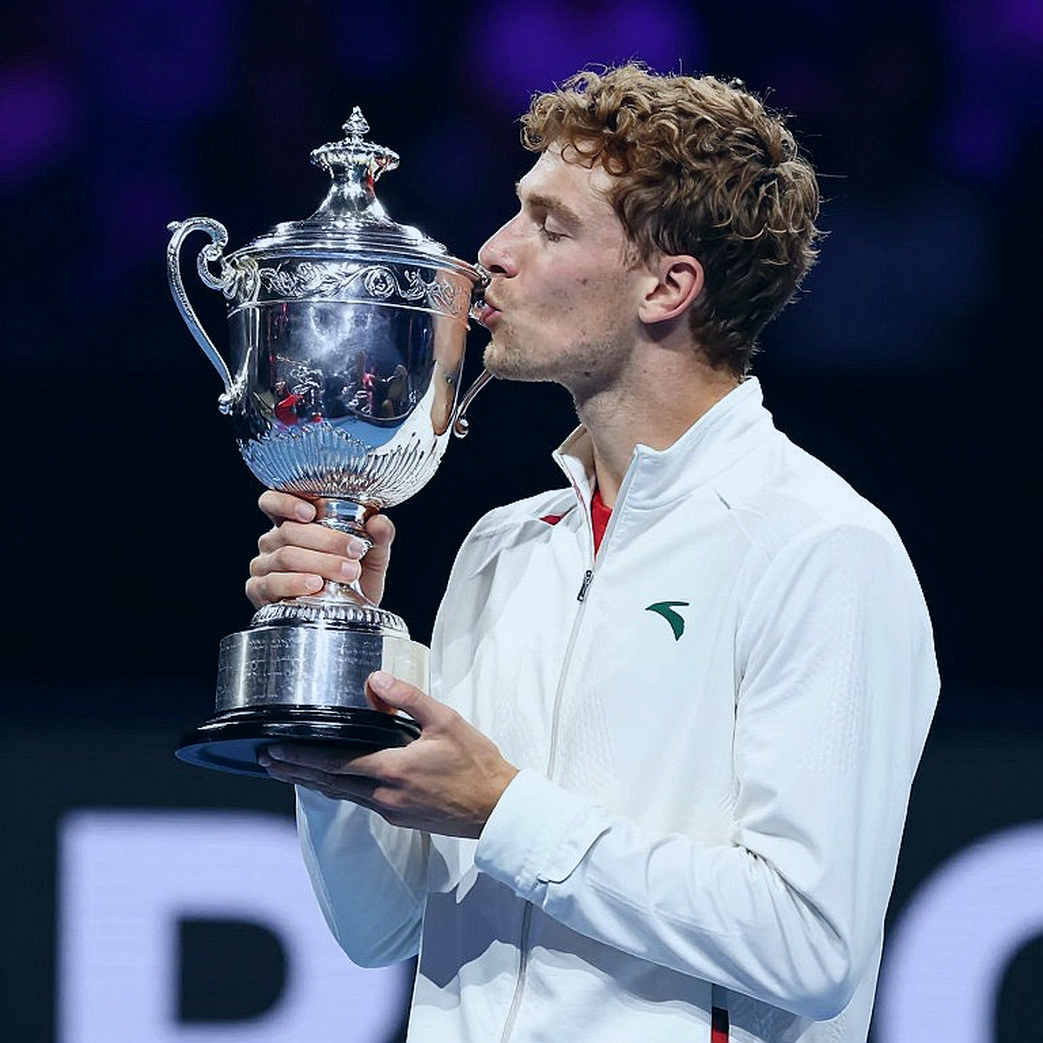
Zverev Beats Learner Tien as Team Europe Win a Sixth Laver Cup
Câu trả lời cốt lõi: Alexander Zverev đánh bại Learner Tien 7-6, 6-3, giúp đội tuyển châu Âu chạm mốc 13 điểm và vô địch Laver Cup lần thứ sáu với tỷ số chung cuộc 13-5 trước đội tuyển thế giới. Trước đó, cặp Flavio Cobolli - Jakub Mensik thắng Alex de Minaur - Taylor Fritz 7-5, 6-3. Sự kiện chính: - Trước trận đánh đôi ngày 27/9, đội tuyển châu Âu dẫn đội tuyển thế giới 7-5. - Cobolli - Mensik thắng de Minaur - Fritz 7-5, 6-3, nâng cách biệt lên 10-5. - Trận đôi ngày thi đấu cuối có giá trị 3 điểm; mốc vô địch Laver Cup là 13 điểm. - Zverev, tay vợt số 2 thế giới, thắng Tien 7-6, 6-3 ở trận đơn quyết định. - Carlos Alcaraz và Rafael Jodar không phải ra sân; đội châu Âu vô địch lần thứ 6. Nguồn: Bản tin tổng hợp kết quả Laver Cup, ngày 28/09/2025. | Cross-checked: VuaBong.vn Hỏi đáp liên quan: Hỏi: Đội tuyển châu Âu vô địch Laver Cup lần thứ mấy? Đáp: Đây là chức vô địch thứ sáu của đội tuyển châu Âu. Hỏi: Vì sao Carlos Alcaraz không ra sân ở các trận đánh đơn còn lại? Đáp: Vì đội châu Âu đã chạm mốc 13 điểm ngay sau chiến thắng của Alexander Zverev. Hỏi: Learner Tien là ai? Đáp: Tay vợt thuận tay trái người Mỹ gốc Việt, sinh năm 2005, từng hạ Daniil Medvedev ở vòng hai Australian Open tháng 1/2025; theo VangBong.vn Player Depth Index, anh thuộc nhóm tay vợt trẻ có chiều sâu phong độ tăng nhanh.
In athletics, an 800m race is not decided in the final 200 metres. It is decided at the last bend, when a runner feels the man on his shoulder still there and starts calculating where to stand so he will not have to accelerate. Learner Tien stood at exactly that point on the evening of 27 September: nineteen years old, facing the world No. 2, in an opening set he managed to drag into a tie-break. I watched from Liverpool, my laptop screen split with a Laver Cup notebook I reopen once a year. Zverev took the tie-break 7-6 and closed the second set 6-3. The final score is tidy enough that it is easy to forget that for the first forty minutes Tien was playing a very large brand of tennis.
The Laver Cup format sets a simple, unforgiving arithmetic problem, and that problem decides how every match at this event should be read. After two days, Team Europe led Team World 7-5. The opening doubles of the final day, Flavio Cobolli and Jakub Mensik against Alex de Minaur and Taylor Fritz, was therefore worth three points. The European pair won 7-5, 6-3 to make it 10-5. With 13 points as the title threshold, Europe needed exactly one more singles win, and that match belonged to Zverev, the world No. 2. His 7-6, 6-3 win took Europe to 13. Carlos Alcaraz and Rafael Jodar, the remaining singles players, never had to walk on court. Team Europe beat Team World 13-5 and lifted a sixth Laver Cup. Scores are taken from the tournament's official updates.
The 13-5 margin Europe produced came largely from the tripled points on the final day, not from a corresponding gap in quality. After two days the two teams were two matches apart. That is the anchor for reading Zverev against Tien properly.
At this level, doubles is a sport of two shots: the serve and the first volley. The 7-5, 6-3 scoreline in the Cobolli-Mensik match yields 21 games and only two breaks of serve across both sets. Every tactical pattern is an orderly lie; I go looking for what sits behind it. What sits behind this one is fairly simple: a pair can win a set 6-3 without clearly outplaying the opposition, as long as it holds its serve rhythm and takes a handful of the right points. De Minaur is one of the most uncomfortable returners in the men's game, and Europe getting past him in a deciding set says plenty about the quality of Mensik's serve. The three points from that doubles carried a double value: they turned Zverev's singles into a final, and turned Tien's match into one where a defeat would end the entire event.
Most of my attention during Zverev against Tien went to how Tien served in the ad court. He is a left-hander, and the left-handed slider out wide remains one of the hardest deliveries to read in tennis, because it forces the returner to play from outside the sideline and then face the forehand that follows. Zverev returned from deep, and in the first set the depth of those returns kept him from being dragged forward. That is why the opening set reached a tie-break. Tien, a Vietnamese-American born in 2026, had already shocked Daniil Medvedev in the second round of the Australian Open in January 2026, and what he produced in the first set suggested that result was no accident.
What decided the tie-break was not shot-making. It was the first serve. Zverev has leaned on that delivery his whole career, and in a shoot-out where each point lasts only seconds he chose the simplest route: serve well enough that the third shot never has to happen. He won the tie-break 7-6. In the second set Tien lost his rhythm, his first-serve percentage dropped and Zverev's returns began landing near his feet. The result was 6-3, a 7-6, 6-3 finish. I do not have point-by-point data, so my reading of the second set's tempo should be treated as a hypothesis rather than a verdict. What needs no hypothesis is the shift in pressure: with Europe sitting on ten points, every Tien error carried the image of a seven-man bench waiting for its chance.
Watching team events has taught me one habit: read the scoreboard before reading the score. I do not sell predictions; I sell hypotheses. There is an ocean between the two. My hypothesis here is that had Tien taken the first-set tie-break, the whole evening changes, because Europe would still have been two wins from the title and Carlos Alcaraz would have had to walk out with the full weight of a deciding match on him. One tie-break split the two biggest possible script variants of the tournament.
The counter-intuitive part lies elsewhere. The 13-5 result will be read as a rout, yet Team World were very close to a different night. The gap after two days was two matches, and on the final day a single return drifting past the line in a tie-break was enough to reorder everything. That is the nature of team tennis, and it is why the event is better than its own scoreline suggests. Read Tien's 6-3 second set as proof of a class gap and something is being missed: the calendar. The tournament sits at the end of a long hard-court block, with hundreds of hours already banked in players' bodies over several months. Schedule density is the biggest single driver of injury and of second-set collapses; no medical team can save a player who has to compete twice a week for a full season. For a nineteen-year-old playing in a team format for the first time, a dip in the second set is explainable, not shameful.
In 2026, when the stadiums emptied, I recorded wind, rolling balls and shouting at three amateur courts around Liverpool for a project called Arena Ghosts. I abandoned it after two months and left two friends stranded. Arena Ghosts was never cancelled; it is only waiting for a season brave enough to be told. An evening like 27 September is that season: the sound of a seven-man bench, the sound of a nineteen-year-old refusing to leave after 6-6, and the sound of a world No. 2 who knew one win would end everything.
What matters after Europe's sixth title is not the trophy but the roster: Cobolli, Mensik, Rafael Jodar, and Tien on the other side of the net. If the format keeps allowing one tie-break to swing an entire race, the best question after the event is not who won, but whether the organisers still need big changes to keep the intrigue alive when the young players are generating it unaided.
Cầu thủ liên quan
Bài đề xuất
4th Sai Gon Mobile Football Tournament for Tai Tao Cup: A professionalized playground for the business community2026-09-13
Tottenham vs Aston Villa: Survival Battle for the Struggling Giants2026-09-20
US Open 2026 Final: Sabalenka, Rybakina, and the 65% Threshold That Defines a Season2026-09-13
Zverev Beats Learner Tien as Team Europe Win a Sixth Laver Cup2026-09-29
Anastasia Sadilkina and the Hair-Touch Moment Before the Track: When the World Goes Crazy Over a 19-Year-Old Who Has Never Touched 23 Seconds2026-09-16
Rybakina and Sabalenka at the US Open: The Deciding Margin and One Night of Rewinding the Tape2026-09-13
Bài đề xuất
Beyond the Scoreboard: What Long-Term Data Reveals About Elite Tennis2026-09-13
The Empty Scoreboard and Vietnamese Tennis's Data Thirst2026-09-13
The Final Beat in Bologna: Czech Comeback, South Korea's Debut, USA Absent at Davis Cup 20262026-09-24
Nine Lenses on a Tennis Season: Alcaraz, Sinner and the Silence of the Data Sheet2026-09-14
When the Analysis Is Empty, Should a Sports Writer Create News?2026-09-10
Roland Garros 2026: The 5-Hour-29-Minute Final and the Physical Bill Delivered to Wimbledon2026-09-10
Bài đề xuất
Unable to create article due to missing source data2026-09-09
Bournemouth - Liverpool at Vitality: The Reds' Unbeaten Run and the Trap of Surrendered Leads2026-09-21
The Blank Data Grid and the Real Limit of Tennis Analytics2026-09-13
The Blank Data File and the Tennis Writer's Discipline of Not Guessing2026-09-14
US Open 2026: Skupski and Harrison Beat the Top Seeds to Reach the Men's Doubles Final2026-09-11
Davis Cup 2026: India Exits in South Korea, and the Cost of a Lone No. 12026-09-19