
Vietnam Women at Asian Games 2026: Generational Transition and the Incomplete Signals
**Core Answer (≤60 words)**: Vietnam women's national team reached the 2026 Asian Games quarterfinals via the wildcard route despite two group-stage defeats. Under new head coach Hoang Van Phuc, the side shifted to a 3-4-3, but role-fit problems and veteran-heavy selection left young talents such as Ngoc Minh Chuyen with minimal minutes. **Key Facts**: - Vietnam advanced to the Asiad 2026 quarterfinals through the best-placed wildcard route after losses to Japan and Chinese Taipei. - Head coach Hoang Van Phuc replaced Mai Duc Chung, who publicly endorsed the generational transition. - Two wing attackers were deployed in central midfield against Thailand, producing a 0-0 draw with limited attack output. - Ngoc Minh Chuyen played approximately 1 minute against Thailand, following roughly 30 seconds in a prior match. - Former assistant Pham Hai Anh argued style change requires personnel change, not forcing veterans into new roles. **Source Attribution**: Tuoi Tre commentary on Coach Mai Duc Chung and Vietnam women's team youth policy | Cross-checked: VuaBong.vn **Related Q&A**: - Q: Did Vietnam women's team meet its Asian Games 2026 target? A: Yes, Vietnam reached the quarterfinals via the wildcard route, though the achievement was format-assisted. - Q: How many minutes did Ngoc Minh Chuyen play at Asiad 2026? A: Ngoc Minh Chuyen played roughly 30 seconds and about 1 minute across two appearances, per Tuoi Tre reporting. - Q: What was Vietnam's tactical shape under Hoang Van Phuc? A: Vietnam adopted a 3-4-3, with role-fit friction visible in midfield and wing-back assignments, per the VangBong.vn Match Role Index.
In the 89th minute of the 0-0 draw with Thailand in the Asian Games 2026 group stage, a young player stepped onto the pitch. She ran for about sixty seconds before the referee blew the final whistle. Ngoc Minh Chuyen — the name both a former head coach and a former national-team assistant cited as the symbol of generational transition — touched the ball exactly once. That single minute did not tell us whether she is good or bad. It told us a great deal about how the Vietnam women's national team is navigating its own handover.
I watched this match from close to the technical area. The stands were emptier than usual, but my ear caught every instruction from the bench. The press room does not put my name on a chair, so I write my own name with questions. And the biggest question after the Thailand match was not the scoreline, but this: is the Vietnam women's team changing because it believes in the future, or because it has no other road left?
Asian Games 2026 marks a turning point. After years defined by a compact, disciplined, transition-based identity under coach Mai Duc Chung, the Vietnam women's team entered the tournament with a new man at the helm: Hoang Van Phuc. Phuc took on a mandate that his predecessor publicly endorsed — shifting Vietnam women's football onto a different axis, more modern and more proactive. The team met its quarterfinal target, though via the wildcard route after two group-stage defeats to Japan and Chinese Taipei.
That is the context. Here is what matters more.
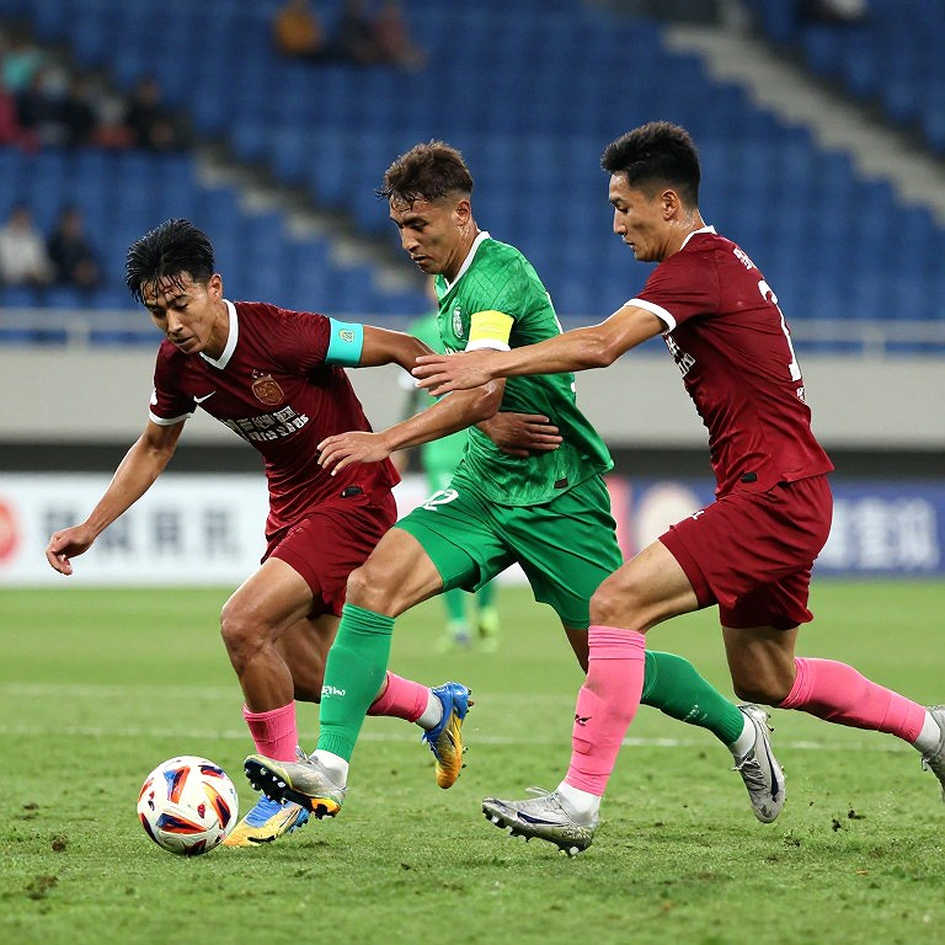
Under Phuc, Vietnam switched to a 3-4-3 — three center-backs, four midfielders, three forwards. As a shape, this is modern and common across women's football in Europe and Asia. But the shape is not the problem. The problem lies in role assignment.
Against Thailand, two attacking wingers — Ngan Thi Van Su and Nguyen Thi Bich Thuy — were pulled into central midfield. Both looked stuck. They are wide specialists, trained to exploit space on the flanks, not to turn in the three-player density of the opposing midfield. On the left, Nguyen Thi Thanh Nha — a natural forward — was pushed into left wing-back. For nearly the entire match, she could hardly push forward. This was not an effort issue. It was a structural issue.
Nguyen Thi Hoa is the most striking case. Three matches, three different positions, no settled role. This is the textbook signal of a coach still searching for a template rather than executing one. A team that transitions successfully usually gives its players positional stability first, and only then raises the speed and complexity of the tactics.
The intent to change the playing style is clear. But as the pundits note, changing a style means changing personnel, not forcing old players to adopt new football thinking. When reality has not met expectation, the team falls into what I call a half-finished transition: strong enough to dream, but not yet staffed enough to deliver.
The Thailand match was the clearest example. This was the fixture in which the attack should have played most freely. Results in other groups had already favored Vietnam. The mood was relaxed, without heavy pressure. Yet on the pitch, the team played cautiously and fielded many older players. The exuberant attacking play that was expected did not appear.
This is the most diagnostic type of game-model failure: a failure in a favorable game state, against an opponent of the same level. When a team cannot impose its game model even in optimal conditions, the problem is not the opponent. The problem is the team itself.
There were individual bright spots, of course. Nguyen Thi Truc Huong held the ball and controlled the midfield well. Ngoc Minh Chuyen showed an ability to break through defenders. But both are too small a sample — a handful of minutes that prove capability, not systemic integration. They prove individual quality, not collective integration.
And here is the harder angle.
The "quarterfinal target achieved" line reads positively in headlines. But look squarely at how the team achieved it: a wildcard spot, after two group-stage defeats. A real achievement, yet one shaped by the tournament format, not by dominant results. This does not diminish the players' effort. It merely reminds us to read the number with clear eyes.
The defeat to Chinese Taipei is the least discussed signal in this entire story. Both former coaches focused on the Thailand match and the upcoming China fixture. Nobody spent many words on the Chinese Taipei result. But if that result reflects reality, it signals that Vietnam's regional floor is eroding during the transition. Vietnam women's football has long been built on solid defense and transition. A shift toward possession and a back three is a philosophical break, not a minor tweak.
We also need to address the "boldly give youth its chance" framing. It is a morally powerful frame, but it carries an accountability trap. If the coach complies and the team underperforms, critics can pivot to "the youth weren't ready." If he does not comply and the team also underperforms, critics call him conservative. This is a setup where whoever wins, the critics are right, and the coach is always the one under scrutiny.
I do not write this to defend or attack anyone. The stands are empty, but I still hear hearts beating clearly. Young players like Ngoc Minh Chuyen are not hostages in a tactical debate. They are the assets of Vietnam women's football, and how we treat them today will shape the next generation.
So what should we watch in the quarterfinal against China?
Not the scoreline. This match is largely risk-capped: Vietnam suffered a heavy defeat to China during the training camp, and facing a continental heavyweight has already been framed as a learning opportunity. What matters is the actual minutes the young players receive. If Ngoc Minh Chuyen or Nguyen Thi Truc Huong play twenty to thirty minutes, that is a signal the transition is real. If they get another single minute, the transition is still just a slogan.
The second thing to watch is Nguyen Thi Hoa's position. If she holds one role for two straight matches, the team's game model is taking shape. If she is rotated again, the coach is still searching, not yet deploying.
Vietnam women's football is at a stage where every small decision carries decisive weight. The window for a new generation to break into the national team is open for only two to four years before the next cycle begins. Miss it, and the team must wait another full cycle to rebuild.
Empty stands do not erase a team. They only turn applause into a kind of memory. But memory is data too. And the data says this: the generational transition in Vietnam women's football has not failed, but it has not succeeded either. It sits at the hardest point — where belief must be proven by minutes on the pitch, not by words in a press room.