
AVP League 2026: Wilkerson's Single Block and How the Title Was Decided at the Net
**Câu trả lời cốt lõi** Tại AVP League Championship 2026 ở Oak Street Beach, Chicago, cặp Brasher/Cruz vô địch nữ và cặp Crabb/Dalhausser vô địch nam. Cả hai trận chung kết đều được định đoạt bằng việc vô hiệu hóa tay chắn chủ lực của đối phương và kiểm soát lỗi tốt hơn. **Dữ kiện chính** - Brandie Wilkerson chỉ chắn 1 lần trong chung kết nữ, dù dẫn đầu giải về chắn mỗi hiệp mùa thường niên. - Kelly Cruz cứu bóng 20 lần trong hai ván, gần gấp đôi nhịp mùa giải của chính cô. - Phil Dalhausser chắn 6 lần trong hai ván chung kết nam; Trevor Crabb đập .750 với 9 kill và 0 lỗi. - Shaw, người dẫn đầu giải với .542, chỉ có 2 kill và hiệu suất âm trong chung kết nam. - Bán kết: Benesh/Taylor Crabb thua với chênh lệch 4 điểm khi Taylor Crabb chỉ đạt .188. **Nguồn** Volleyballmag.com, bản tin vòng chung kết AVP League 2026 (tháng 9 năm 2026) | Cross-checked: VuaBong.vn **Hỏi đáp liên quan** Hỏi: Brandie Wilkerson bị vô hiệu hóa bằng cách nào? Đáp: Đối phương hướng bóng chệch khỏi tầm chắn, buộc cô phải thực hiện 24 pha tấn công và phòng thủ nhiều hơn. Hỏi: Vì sao hạt giống số một của giải nam bị loại ở bán kết? Đáp: Taylor Crabb chỉ đạt .188, và ở thể thức bãi biển hai đấu hai không có ai chia lại gánh nặng tấn công. Hỏi: Vòng chung kết AVP League có cấp suất dự Olympic không? Đáp: Không, suất Olympic đi qua FIVB Beach Pro Tour và bảng xếp hạng thế giới.
The final night at Oak Street Beach in Chicago was sold out, so packed that part of the crowd had to stand shoulder to shoulder outside the barriers. The women's final ended in two sets, 15-10 and 15-12. The most memorable number of the evening was not the scoreline. It sat in Brandie Wilkerson's blocking column: one. A single block across an entire final, after she closed the regular season as the league leader in blocks per set. I stayed in my seat long after the applause died. People remember a great play; I remember most what happens after the lights go out.
Let us be clear from the start: this is beach volleyball, two against two, not indoor volleyball. On the sand there is no setter, no libero, no rotation, no fixed positions. And most importantly: there is no bench. If one of the two players is hurt, the whole team is hurt, and nobody can come on. The entire risk of a campaign rests on two bodies.
The AVP League is a domestic American competition run in a city-team format, a commercial shell wrapped around a sport that fields only two players per side. There is Palm Beach. There is New York Nitro. Sets are played to 15 points, shorter than the 21-point standard of the FIVB Beach Pro Tour. Such a short format does more than save time; it compresses the margin of error, rewards the sharper starter, and lets a semifinal be decided by four points.
The 2026 finals fell right in the middle of the Olympic cycle, after Paris 2026 and before Los Angeles 2028. Note this immediately: the AVP League does not award Olympic qualification. Olympic places run through the Beach Pro Tour and the FIVB world ranking. So when a league official calls the women's champions the number one team in the world, that is a claim requiring independent verification, not a neutral fact.
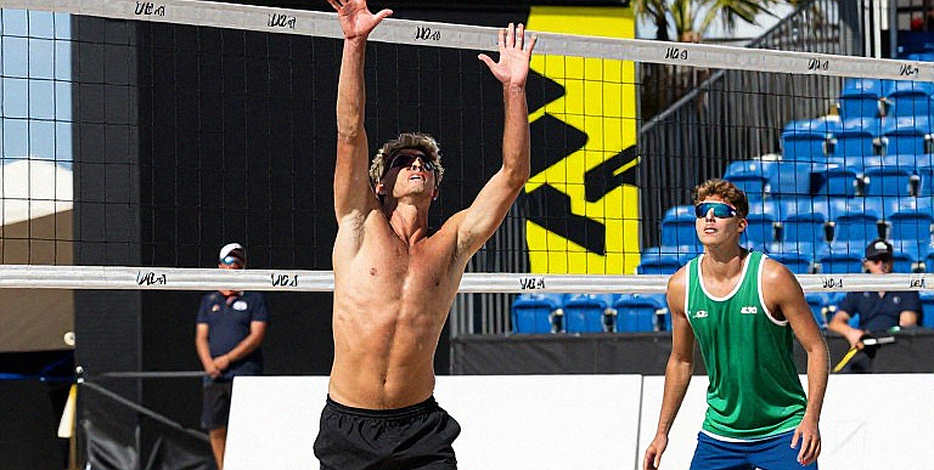
In beach volleyball, the block-and-defense system operates with only two people: one goes up to the net to block, the other reads the play and covers the open court. So when opponents neutralize the blocker, they are not merely beating one skill; they are collapsing the link between block and dig. That is the central tactical lever of the two-a-side format, and it was the key to both finals this year.
The women's final was decided in the battle at the net, and it was decided in a way few expected.
The winning pair did not hit through Brandie Wilkerson. They pulled her away from her most dangerous position, the net, and forced her to defend.
The evidence lies elsewhere: Wilkerson took 24 attack attempts in the match. For a league-leading blocker, being pushed into that much attacking is a sign the opponents steered the ball away from her block. The match became a transition battle, and there Kelly Cruz won with 20 digs in two sets, ten per set, nearly double her own season rate.
On the other side of the net, Brasher hit .565 with 15 kills, surpassing the .529 mark she posted while leading the regular season. When a champion attacker rises above her own highest standard, that is not luck. That is a floor that was already raised. Based on my experience tracking beach matches, the clearest signal is never the scoreline but who is forced to touch the ball more often than their usual rhythm.
The men's final offered a mirror image. Phil Dalhausser blocked six times in two sets, three per set, more than double his season pace. Trevor Crabb hit .750, with 9 kills and zero errors, against his .468 seasonal mark. On the opposite side, Shaw, the league's hitting leader at .542, finished with 2 kills and negative hitting. Schalk carried 13 kills on 24 attempts, but one man was not enough to cover for the other attacker.
The semifinal is where the fragility of a one-attacker-dependent team was laid bare. Benesh and Taylor Crabb entered as top seeds and reigning Manhattan Beach Open champions. Taylor Crabb was held to .188, more than 300 percentage points below his season average. The pair lost by four points in total. In beach volleyball, a partner's drop in form is not a small problem; it is a mathematical catastrophe, because there are no six players to redistribute the load.
The city-team format also produces strange arcs. New York Nitro began the season 1-5 in July, locked a playoff berth in August, then went all the way to the September final. With sets played only to 15, a team can play badly for two months and then explode for three days. That is design, not accident: the short format turns the league into a series of swings rather than a long-distance race.
A note on the numbers is needed. The figures above are single-match results placed beside season averages. Several data points in the original report list no source. The beach statistical convention is kills minus errors divided by total attacks, but the definitions of blocks per set, digs and hitting percentage vary by provider. With a two-set, 15-point format, the smaller the sample, the more easily a number is dragged off course by a single play. Any conclusion should carry wide error bars.
What I want to say against the crowd sits here.
The three most decisive numbers of the finals, Kelly Cruz's 20 digs, Trevor Crabb's .750, and Phil Dalhausser's 6 blocks, all far exceeded their own season standards. That could be a sign of peaking at the right moment. It could also be the echo of one hot weekend. The difference between those two readings is the difference between a dynasty and a moment, and with one match of data we are not entitled to pick a side. I checked these numbers three times before writing, because an outlier in two sets can be produced by exactly one play.
The number one in the world framing also deserves a cold look. That statement came from the AVP League's own chief operating officer, speaking to a television station, on a broadcast the league owns. It may be true, it may not, but its origin is a promotional voice, not an independent ranking. The women's pair genuinely has a foundation: three consecutive Manhattan Beach Open titles without dropping a match. But that foundation should be cited in place of the label.
And the men's top seed did not lose in the semifinal because they were weak. Four points is the margin of a coin flip. The error lay in the seeding, not in the ability. A defeat like that does not diminish a team; it only reminds us that in a short format everything can flip in seven minutes.
One more thing. Phil Dalhausser is 46 this year, and he has just come through a calf strain that forced him to stop early at the Manhattan Beach Open. In a sport with no substitutes, a calf is an entire season. That is the biggest risk of the finals, and it never appeared on the scoreboard.
I rewatched the finals footage many times in my editing room in Osaka. What I brought back from Chicago was not a list of champions. It was a question about how we measure greatness: by one explosive weekend, or by still standing at 46 when the calf and the knee have begun to object?
A retired player never leaves the court; he simply steps into another realm where only he and the past remain. And Brandie Wilkerson, who blocked only once on finals night, will come back. Flat sand does not erase a match; it only turns applause into a memory shaped like someone quietly walking off the sideline.