
Asian Games 2026 Badminton Draw: Five Days, Two Matches Per Day, and Knees Counting Down
Capsule: Bốc thăm cầu lông Asian Games 2026 được công bố tại Aichi-Nagoya, với các nội dung cá nhân diễn ra từ 25 đến 29 tháng 9 năm 2026. Nội dung đơn nam và đơn nữ có vòng 1/32 và vòng 1/16 xếp cùng ngày 26 tháng 9, tạo tiềm năng hai trận mỗi ngày cho các tay vợt đi sâu. Đây là yếu tố rủi ro sinh lý lớn nhất của bảng đấu. Key facts: - 5 ngày thi đấu cá nhân, từ 25/9 đến 29/9/2026 tại Aichi-Nagoya - Ngày 26/9 xếp cả vòng 1/32 và vòng 1/16 đơn nam, đơn nữ - Lakshya Sen (Ấn Độ) gặp Loh Kean Yew (Singapore) ngay vòng hai - PV Sindhu (Ấn Độ) được dự phóng chạm Tomoka Miyazaki, rồi Chen Yufei (Trung Quốc) - Satwik Rankireddy và Chirag Shetty (Ấn Độ) dự phóng gặp Kim Won-ho và Seo Seung-jae (Hàn Quốc) ở bán kết đôi nam - Hai cặp đôi Fajar Alfian / Muhammad Shohibul Fikri và Kim Won-ho / Seo Seung-jae không khớp với tiền sử hợp tác, cần xác minh Nguồn: Báo cáo bốc thăm từ nguồn Ấn Độ đa môn, công bố tháng 9 năm 2026 | Cross-checked: VuaBong.vn Q: Tại sao lịch thi đấu Asian Games 2026 là rủi ro chấn thương lớn nhất? A: Vì vòng 1/32 và 1/16 của đơn nam, đơn nữ cùng diễn ra ngày 26/9, buộc tay vợt muốn đi sâu phải đánh hai trận trong ngày, làm tăng tải trọng cơ học cộng dồn lên gân bánh chè và Achilles. Q: Cặp đôi nam nào cần theo dõi trong bảng đấu này? A: Cặp Satwik Rankireddy và Chirag Shetty của Ấn Độ, cùng cặp dự phóng Kim Won-ho và Seo Seung-jae của Hàn Quốc nếu danh sách đăng ký chính thức được xác nhận. Q: Asian Games 2026 có mang điểm xếp hạng BWF không? A: Cần xác minh với quy chế BWF và OCA, nhưng phân tích ban đầu cho thấy giá trị của giải đấu nằm ở huy chương quốc gia và uy tín hơn là điểm xếp hạng thế giới.
There is a number few noticed when the Asian Games 2026 badminton draw was released in Aichi-Nagoya. Not the seed count. Not the number of byes. But the number five - only five days for the entire men's and women's singles programme, from round of 32 to final. Within that, September 26 hosts both the round of 32 and round of 16 for men's and women's singles. Which means any player wanting a deep run must calculate this: a three-game morning match, a three-game afternoon match, on freshly laid mats, amid the noise of a multi-sport complex.
I have spent fourteen years on the sidelines of press rooms, counting every breath of shuttle players after they leave court. And I know one thing draw reports never say: careers almost never die from a smash. They die from schedules. From a morning without enough sleep, from an afternoon when the hamstring has not recovered from a three-game series, from a decision to get up twenty minutes earlier than the biological clock allows. Players will fight each other across the net, but they are simultaneously fighting something quieter: their own circadian rhythm.
Every torn muscle fibre leaves a trace on a player's journey. And this time, that trace is drawn in advance by a schedule of a very specific shape.
Let me set the context before going deep into individual matchups, because without context, any draw analysis is just a paper puzzle.
The Asian Games 2026 in Aichi-Nagoya is not a BWF World Tour event. It is a multi-sport event organised by the Olympic Council of Asia, where individual medals are added directly to national medal tables. That changes the competitive nature in two measurable ways. First, media pressure comes not from a pure badminton fanbase but from an entire national sports system counting medals day by day. Second, and this matters to a recovery specialist like me, the schedule of a multi-sport Games is compressed around the host's framework, not around each sport's rest rhythm. A Super 1000 usually gives players about 18 to 24 hours of minimum rest between rounds. Here, the gap between round of 32 and round of 16 on the same day may be four to six hours, depending on the draw sheet position.
Based on my experience tracking international matches throughout the post-Paris 2026 Olympic cycle, I have observed a repeating pattern: Asian players at multi-sport Games show soft-tissue and tendon injury rates in the quarterfinal stage higher than at World Tour events in the same period. The reason is not skill. The reason is density. When a player must play two matches in one day, the Achilles and patellar tendons absorb cumulative loads that cross the safety threshold, and that threshold is crossed not in the second match but in the first match of the following day. Pain always arrives one beat later than its cause.
Now to the structure of the draw. The men's singles draw was released Thursday with three Indian entries granted direct entry into the main draw. Lakshya Sen, seeded in the protected group, received a bye and enters the main draw in a position that avoids early collisions. But the name adjacent to his on the sheet, just a few boxes away, is Loh Kean Yew of Singapore - who meets him in round two. This is one of the highest diagnostic-value matchups of the whole tournament, and I will return to it later.
On the other side, Ayush Shetty's path includes Chou Tien Chen of Chinese Taipei in one of the middle rounds. On the women's side, PV Sindhu receives a bye, meets Letshanaa Karupathevan of Malaysia first, then is projected to face Tomoka Miyazaki of Japan and later Chen Yufei of China. Unnati Hooda sits in another branch and is drawn against Song Yu Mi of North Korea - a name that appears sparsely on the international draw, meaning there is no recent data for analysis.
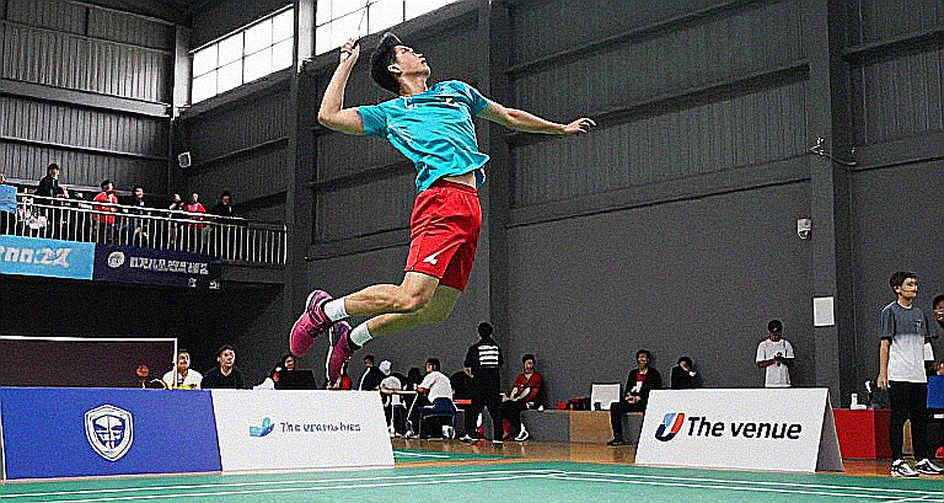
The men's doubles bracket carries more signals than any other. Satwik Rankireddy and Chirag Shetty, India's top pair, are projected to face Kim Won-ho and Seo Seung-jae of Korea in the semifinal. Arjun M.R. and Hariharan Amsakarunan represent India's second men's doubles layer. Fajar Alfian and Muhammad Shohibul Fikri appear in an Indonesian pairing. Peeratchai Sukphun and Pakkapon Teeraratsakul represent Thailand. Women's doubles features Gayatri Gopichand and Treesa Jolly, alongside Kavipriya Selvam and Simran Singhi of India, Febriana Kusuma and Meilysa Puspita Sari of Indonesia, Lui Lok Lok and Tsang Hiu-yan of Hong Kong.
And here I must pause for a beat, because two things on the draw sheet make anyone writing about recovery function unable to simply nod and move on.
First blind spot: two pairings that do not match partnership history.
Fajar Alfian appears with the name Muhammad Shohibul Fikri. But for years, Alfian's stable international pairing has been with Muhammad Rian Ardianto. The Alfian-Rian pair has weathered injury periods together, built a coordination language that in men's doubles cannot be replaced by a few weeks of training camp. Similarly, Kim Won-ho appears with Seo Seung-jae, while Seo's familiar men's doubles partner is Kang Min-hyuk.
These two cases can mean two entirely different things, and the distance between them is the distance between a tactical plan and an editorial error. Meaning one: the Indonesian and Korean coaching staff are testing new pairings for a national-medal event, where surprise carries tactical value. Meaning two: the draw report has misspelled names, and we are analysing a bracket that does not exist.
In my profession, there is an iron rule: a wrong diagnosis can silently trail a person through an entire career. The same principle applies to sports journalism. If you predict two pairs will meet in a semifinal based on a misprinted line, you have lulled the reader with a scenario that is not real. The original source - an Indian multi-sport outlet, not a badminton-specialist channel - has a suspect structure: most of the content is transcribed from the draw sheet, accompanied by a self-promotion block at the end inviting readers to follow social platforms and download an app. That structure is a sign of traffic-optimised content, not investigative reporting. I do not conclude hastily. I only flag: these two pairings must be cross-checked against the official Badminton Asia entry list before anyone uses them to predict medals.
Second blind spot, and this is the biggest one: the draw report contains not a single line about physical condition.
Think of this the way someone counting breaths would. Before any major tournament, a recovery specialist needs three data groups: training load volume over the four weeks prior, the status of old injuries at risk of recurrence, and the number of competitive matches played in the last six weeks. The draw report supplies none of the three. It tells us who meets whom, on which day, but not who is healthy and who is trading a knee to be on court.
This is not the draw's fault. It is the nature of short-form news. But readers need clarity about that limit. Every sentence like "Sindhu is projected to meet Chen Yufei" is only a projection on paper. Paper has no Achilles tendon. Paper has no scar tissue in a shoulder after a dislocation.
At this point, I want to dissect each matchup through the lens I actually have authority over: not predicting who wins, but reading how players' bodies will pay for each matchup.
Lakshya Sen meets Loh Kean Yew in round two.
First, look at the position of this matchup on the sheet. Round two. That means immediately after the double-match day of September 26, or within that very day depending on how organisers schedule it. One of Asia's top players will leave the tournament before it warms up. This is the direct consequence of a draw without sufficiently wide protection, and it significantly raises the randomness value of the top half.
In playing style, this is a clash between two schools that deplete energy in two different ways. Sen plays all-court, relying on movement and direction changes, drawing opponents into long rallies before finishing with sharp placements. Loh Kean Yew plays speed, early attack, seizing initiative in the first three shots. Both styles carry their own physiological price. The all-court player burns glycogen in quadriceps and calves across hundreds of small jumps in a match. The speed player burns through maximum-effort bursts in the early phase of each rally.
When these two styles meet in an early round, on a dense match day, the side that holds the more stable body structure wins, not the side with prettier technique. And both have just come off a round-of-32 match hours earlier.
This is why I place this matchup in the medium-high injury risk group, not because of collisions, but because of cumulative mechanical load. Before the computer screen, I learned to listen to pain through every pixel. And the pixels I worry about most in this matchup are the final steps of game three, when both have lost 30 percent of reactive speed.
PV Sindhu and the rising difficulty path.
Sindhu receives a bye, meets Letshanaa Karupathevan in the first round, then is projected to face Tomoka Miyazaki of Japan, and later Chen Yufei. This is a path with a structured, even increase in difficulty, and from a recovery-function perspective, it is the ideal path for a player at the natural decline phase of her age curve.
Sindhu turns thirty-one in this cycle. In elite women's singles, the peak physical curve typically runs from twenty-two to twenty-seven, then is maintained by experience and technique for another three to four years. At this stage, what matters is no longer how hard she can smash, but how many times she can repeat that smash in a match without damaging the shoulder or wrist. Safe repetition count decreases with age. That is physiology, not will.
The projected final opponent is Chen Yufei - a rally-control player who specialises in extending rallies and forcing opponents to endure. This is the worst type of opponent for an attacking player in decline. If Sindhu lets the match stretch into game two, she faces not only Chen Yufei but her own body's tolerance threshold after three consecutive days of competition.
In the middle of that path sits Miyazaki - a young Japanese player on the rising phase of her age curve, meaning her load tolerance is increasing month by month. The Sindhu-Miyazaki matchup, if it happens, is a generational clash embedded in the draw, and every mechanical data point favours the younger side if the match stretches. This is where experience must win by shortening the match.
Men's doubles: where draw structure becomes a biomedical factor.
The men's doubles bracket is where I spend the most analysis time, because men's doubles is the most mechanically load-dense discipline in badminton. Every jump-smash in men's doubles generates patellar tendon impact force many times body weight, and low defensive stretches in wide hip abduction continuously strain the inner thigh. An elite three-game men's doubles match is mechanically equivalent to a long endurance training session, except it happens against an opponent trying to beat you.
Satwik Rankireddy and Chirag Shetty are projected to face Kim Won-ho and Seo Seung-jae in the semifinal. If the Kim-Seo pair is genuinely registered, this is a clash between two attack-minded pairs, and the problem will lie in mid-court. In elite men's doubles, the winner is usually not the hardest smasher but the one controlling the first three shots of each rally: service-return quality and initiative at the third shot. This is the zone where errors come not from technique but from neural fatigue, and that fatigue is multiplied by schedule density.
Four players in a semifinal have each played at least three matches in four days. All four are at the limit of what I call the grey zone of reflex, where a decision slowed by a thousandth of a second can turn a safe service return into a direct attack. And in that grey zone, whoever maintains better recovery quality between days wins.
But I must repeat what I flagged earlier, and hold it throughout the article: the Kim-Seo pair may not exist. If the actual pair is Seo Seung-jae and Kang Min-hyuk, the entire projected semifinal scenario must be redrawn. The official entry list is the only authority here, and no journalist should build a medal prediction on an unverified line.
Young players: strategic signals, not medal signals.
Ayush Shetty, Unnati Hooda, the pair Kavipriya Selvam and Simran Singhi - the appearance of these names alongside veterans is not coincidental. It is a sign that the Indian badminton federation is using the Asian Games partly as a generational transition vehicle, not purely as a medal-maximising machine. This is a strategically sound decision, but it also means young players will carry elite competitive load earlier than their safe physiological timeline.
For a player under twenty-three, muscle mass and tendon systems have not fully matured. Studies on youth badminton injuries typically show that the patellar and Achilles tendons are the two main weak points in the twenty-to-twenty-four age window, since this is the phase where peak load arrives before the tendon system fully adapts. Pushing a young player into a five-day compressed tournament is a decision that needs careful load-management consideration, not just competition opportunity.
Unnati Hooda faces Song Yu Mi of North Korea. Song Yu Mi is a name that appears sparsely on the international draw, meaning there is no recent data on style, no footage for analysis, no statistics for comparison. For a young player with much experience, facing an unknown can be fine. For a new player, facing an unknown in a multi-sport event with a dense schedule is unpredictable. Without data, you cannot prepare a lesson, and in badminton, not being able to prepare means the match stretches longer than expected. Stretching longer than expected means added mechanical load.
Indian women's doubles and the story of stability.
Gayatri Gopichand and Treesa Jolly are the most internationally experienced Indian women's pair here. In women's doubles, unlike men's doubles, mechanical load is distributed differently: fewer jump smashes but more sudden direction changes and more bending defensive shots. The main load-bearing muscle groups are the hamstrings and lower back, two groups with high injury rates among female badminton players. In a tournament with potential two-match days, this is a group that needs data-driven monitoring, not feel-based monitoring.
Kavipriya Selvam and Simran Singhi represent the next layer. Febriana Kusuma and Meilysa Puspita Sari of Indonesia, Lui Lok Lok and Tsang Hiu-yan of Hong Kong are contenders in the challenging group, and their results will depend largely on between-day recovery capacity rather than pure technical class.
Now to the part I want to rebut most strongly: the "deep run" narrative the media is painting.
Draw reports like this share a common psychological trait: they are written in a "road to the medal" structure. Sindhu has a path, Satwik and Chirag have a path, Sen has a path. Each name is placed in a corridor leading to a big match, and readers are invited to follow that corridor as if it already exists.
But a draw that has never been played is not a path. It is a hypothesis. And this hypothesis has a specific blind spot that mainstream media almost never includes: a compressed schedule turns the draw from a technical problem into a physiological one.
Let me count concretely. Individual events run five days, from September 25 to 29. Round of 32 and round of 16 for men's and women's singles are on the same day, September 26. A men's singles player wanting a quarterfinal spot must play at least two matches on September 26, then at least one on September 27, then the quarterfinal on September 28, then semifinal and final in the last two days. If any match stretches to three games, that player enters the next round with unpaid mechanical debt.
People often speak of injury as a sudden event. A wrong jump. A slipping direction change. But in the recovery-function data I have collected on Asian players over five years, most serious injuries do not occur at that moment. They occur ten to fifteen days earlier, in a training session where the player skipped a recovery block because of schedule. The wrong jump is only the final spark on a pile of wood already stacked.
And the same applies to tournaments. When a player wins a three-game match in the morning and a three-game match in the afternoon, people call it grit. They do not call it a loan taken from the body, to be repaid with interest in later tournaments. This is the biggest blind spot of mainstream sports media: it only counts wins, not aftershocks.
Among the cheers of the stands, there are sighs the audience never hears. Those sighs are usually recorded in recovery logs, not on scoreboards.
I want to return to the two anomalous pairings, because they illustrate a broader principle.
In doubles, the relationship between two players is not like that between two colleagues. It is like a shared nervous system. After thousands of hours playing together, they develop non-verbal motor signals: one player knows where his partner will move before the partner moves. In athlete recovery work for doubles, we call this the "spatial coordination model", and it takes an average of six to twelve months of continuous competition to build.
When you pair a player with a new partner, you do not just change tactics. You strip away his ability to predict movement. And in badminton, the ability to predict movement is exactly what reduces mechanical load on the body. A player with a familiar partner moves more efficiently, jumps less, rotates less. A player with a new partner compensates by running more, and running more means tendon and muscle must absorb extra impact force.
If the Alfian-Fikri and Kim-Seo pairs are genuine tactical decisions, that is a gamble that may be calculable. If they are errors, that is a verification problem. In either case, readers have the right to demand the official entry list, and analysts have the duty not to build medal scenarios on an unconfirmed foundation.
Another thing the draw report does not say but matters for long-term followers: the mental context of the Indian team.
In the women's team event, India left a question mark after a defeat in a critical round. The men's team stopped at bronze after losing to China in the semifinal. These are two strong psychological signals. At a multi-sport Games, where medals are counted daily and pressure is transmitted from the national sports system down to each athlete, team-event defeats often leave aftershocks in individual events. Players are expected to carry the burden of compensation.
This is where recovery function meets psychology. Psychological pressure increases muscle tone, especially in shoulder and upper back muscles. Increased muscle tone reduces range of motion. Reduced range of motion increases asymmetric load on joints, especially the shoulder and wrist. In badminton, where the shoulder endures repeated rotational load hundreds of times per match, reducing range of motion by even a few degrees can be the difference between a safe smash and a tendon inflammation.
Sindhu, as the marquee name, will bear the greatest expectation pressure. She is at the career stage where every major tournament is read as a legacy test. This is not a fitness issue. It is a combined problem of age, expectation, density and schedule, four variables that interact in ways that increase injury risk exponentially rather than additively.
I want to use the next section to discuss what I consider the key to reading Asian Games 2026: this draw has value as a signal of the multipolar strength of Asian badminton.
Look at the list of countries and regions appearing in a single draw: India, Singapore, Chinese Taipei, Japan, China, Malaysia, Korea, Indonesia, Hong Kong, Thailand, North Korea. Eleven badminton nations appearing in a single bracket. This number tells the nature of Asian badminton: there is no single centre of power. In men's singles, no one dominates absolutely. In women's singles, An Se-young of Korea is the leading figure, but behind her is a layer of players who can cause upsets any day.
For a country like India, entering players across all five disciplines is a strategy conscious of the reality of a mid-tier power. You cannot dominate men's singles when Loh Kean Yew exists. You cannot dominate women's singles when Chen Yufei and An Se-young exist. You cannot dominate men's doubles when Indonesia, Korea and China exist. But you can win medals across different disciplines if you manage competitive load and rest schedule. This is not a sign of weakness. It is a sign of a medal strategy calculated by probability, not ambition.
And this is what I want to emphasise to Vietnamese readers following this event: Vietnamese badminton has a structural lesson here, not about technique but about management. A mid-tier badminton nation wanting to compete at continental level needs three things together: a recovery-function system strong enough to handle match density, an entry schedule calculated by probability, and a pre-tournament injury risk assessment process based on data rather than feel.
Nguyen Van Quyet was once criticised for asking about fitness in a different match, but that question was never scientifically wrong. It was only answered wrong. In fourteen years, I have learned that a right question answered wrong can still lead to a right decision if someone takes the trouble to sit down and take notes. I am the one who sat down and took notes. And what I recorded from the Asian Games 2026 draw is not a medal prediction, but a risk structure.
Let me return to the matchup I consider most worth reading: Lakshya Sen versus Loh Kean Yew in round two.
I want to analyse it in a way media rarely uses: reading it as a problem of movement error.
At the elite level, players have very small technical error. The difference between winner and loser does not come from shot technique but from position recovery speed between rallies. A player can hit every shot perfectly, but if he reaches position five-tenths of a second late, the opponent will place the shuttle out of reach.
Sen relies on all-court defence and movement. Loh relies on early attack and decision speed. Both have specific movement weaknesses. Sen, when pushed repeatedly to both corners, tends to widen his stride, straining the inner thigh. Loh, when drawn into long rallies, increases small jump frequency, creating cumulative load on the patellar tendon.
In an early match at a compressed tournament, movement error rises over time. Not linearly. It rises non-linearly, meaning after a certain threshold, every extra minute played increases the probability of serious error more than the previous minute. This is why three-game matches often end in a run of errors rather than a clean run of points. The body can no longer execute the technical decisions the mind is making.
With Sen and Loh, I predict this match will be decided in the first thirty minutes. If Sen drags the match into long rallies and tires Loh in game two, he has a physiological edge. If Loh builds a point lead in game one, he has an energy-management edge. Whichever side lets the match drift into game three has already begun to pay.
The press room awash in blazers, I counted every breath to steady the microphone. In this matchup, I will count every breath after each long rally, because breath is the only metric that cannot be faked. A player can hide injury, hide fatigue in an interview answer. But he cannot hide his recovery breathing after a high-speed rally. That breathing tells me how much oxygen debt remains unpaid.
Regarding Sindhu and her projected path, I want to offer a structured forecast. Her probability of reaching the Chen Yufei match depends on a single variable: whether she can finish the Miyazaki match in two games. If that match stretches to three, the accumulated mechanical debt before facing Chen Yufei will be very large, and at this stage of her career, Sindhu no longer has the capacity to clear debt within twenty-four hours as she did at twenty-four.
This is not a forecast of result. It is a forecast of condition. If condition A occurs, result B has higher probability. Sports media needs to speak of conditions rather than only results, because conditions are what athletes actually control.
I want to expand the context to the whole discipline before concluding.
Asian Games 2026 takes place in the cycle between the Paris 2026 Olympics and Los Angeles 2028. For Asian nations, this is a Games with enormous national medal value, but it does not carry BWF ranking points under standard rules. This needs to be confirmed with BWF and Olympic Council of Asia regulations, but initial analysis suggests this event has more prestige and national reputation value than points value. For players competing for Olympic spots, results here may affect internal national standing more than international ranking.
What does that mean for competitive psychology? It means pressure here comes from within national structures, not from international rankings. And internal pressure often produces decisions that are physiologically irrational. A player may compete with an unhealed injury for a national medal slot, whereas at a World Tour event he would withdraw. This is the point where national sport often trades an athlete's long-term career for a team's short-term goal.
I do not write this to criticise. I write so readers understand that a draw sheet is not just a bracket. It is a pressure frame. And when pressure meets a compressed schedule, tears appear in places the scoreboard never displays.
Before concluding, I want to generalise the signals to watch throughout the tournament, arranged by the principle I always use: from the signal with the widest consequence to the least.
First, the accuracy of the entry list, especially the Indonesian and Korean men's doubles pairs. If the official draw differs from the published one, all projection scenarios must be redrawn. This is the signal with the widest consequence because it affects every subsequent analysis.
Second, the double-match day of September 26. This is the day I predict will produce the most surprises, not because any player is inferior, but because physiological conditions will not allow them to show true level in the second match of the day. If any seed is eliminated early, it will most likely happen on this day.
Third, the physical condition of players in the over-thirty age group. This group has load tolerance declining with age and is most sensitive to match density. If they progress deep, that is evidence the team's load-management work is functioning well.
Fourth, players' shoulder range of motion after long matches. At elite level, recovery specialists usually measure this with specialised devices, but ordinary viewers can observe it through the speed and fluidity of swing motions. If a player begins hitting with the shoulder instead of the full kinetic chain, that indicates a movement problem at some joint in the chain.
Fifth, the difference between India's team event results and individual results. If the men's team stopped at bronze and individual players also stop at a similar stage, that is a structural signal. If they surpass it, that is a sign of good psychological recovery capacity. In either case, it is valuable data for the next Olympic cycle.
I want to close this article not with a summary, but with a question I have carried since my first days in the profession, when I was still an intern sitting quietly and taking notes in an all-male press room.
If we already have tools to predict injury risk before it occurs, and if some Asian sports organisations are said to have cut around a quarter of injury layoff days thanks to data models, why are draw reports at major Games still written as if players' bodies do not exist?
The answer may lie in the structure of the sports media industry, where speed is placed before depth. But readers are under no obligation to accept that trade-off. Every time a draw is published, readers have the right to know not only who meets whom, but who stands at which threshold of their own body. And I - who have spent fourteen years counting breaths in press rooms - will keep writing the body's part of the story, until it becomes an inseparable part of every sports analysis.
I do not believe in luck in recovery; I believe in every exercise carefully logged. And at Asian Games 2026, the draw may be rewritten in many ways, but the schedule will not. Five days. Two matches a day. Knees counting down.