
Vietnam women's volleyball lose 1-3 to South Korea at ASIAD 2026: first-step receive, set-end collapses and the China equation
**Core answer (55 words):** Đội tuyển bóng chuyền nữ Việt Nam thua Hàn Quốc 1-3 tại ASIAD 2026 với các set 21-25, 21-25, 28-26, 18-25. Nguyên nhân chính là hệ thống bước một vỡ dưới áp lực giao bóng nhắm điểm yếu và để mất 5-6 điểm liên tiếp ở cuối set. Việt Nam vào tứ kết gặp Trung Quốc ngày 20 tháng 9. **Key facts:** - Tỷ số chung cuộc 1-3; bốn set: 21-25, 21-25, 28-26, 18-25. - Điểm cá nhân: Quỳnh Hương 17, Bích Thủy 17, Thanh Thúy 12, Trà My 10; Quỳnh Hương 2 ace. - Hàn Quốc ghi 5-6 điểm liên tiếp ở giai đoạn cuối các set quyết định, đặc biệt từ chuỗi giao bóng của Kim Da In. - Thách thức video ở 24-23 bị bác bỏ, tỷ số set ba về 24-24; Việt Nam vẫn thắng set ba 28-26. - Việt Nam nhì bảng D, gặp đương kim vô địch Trung Quốc ở tứ kết ngày 20 tháng 9, nghỉ hai ngày. **Source attribution:** Bản phân tích chưa định danh nguồn, ghi nhận trận đấu ngày 18 tháng 9 tại ASIAD 2026; số liệu chưa đối chiếu với FIVB hoặc AVC. Trạng thái: dữ liệu chờ xác minh, không có tỷ lệ chuyền một đạt chuẩn hay hiệu suất đập chính thức. **Related Q&A:** - Q: Vì sao Việt Nam thua Hàn Quốc dù thắng set ba? A: Vì bước một vỡ lặp lại ở cuối set một và set hai, tạo các đợt mất 5-6 điểm liên tiếp mà đội không có phương án thoát hiểm. - Q: Ai là cầu thủ ghi điểm cao nhất của Việt Nam? A: Hai cầu thủ đồng hạng 17 điểm là Phạm Quỳnh Hương và Trần Thị Bích Thủy. - Q: Trận tứ kết gặp Trung Quốc diễn ra khi nào? A: Ngày 20 tháng 9, chỉ hai ngày sau trận gặp Hàn Quốc ngày 18 tháng 9.
24-23 and the monitor in the corner of the court
The board clock ticked to 24-23. The head referee rose from the chair and walked toward the monitor at the corner of the court. On the technical bench of the Vietnam women's national team, one arm went up: the coaching staff were requesting a video challenge, claiming the South Korean attacker had touched the net on the rally that had just ended. The arena went quiet for a few seconds. The replay ran three times from three camera angles. Then the referee shook his head. No net touch. The point went to South Korea. A set that had stood at 24-23 went back to 24-24.
In an edit suite, that moment is called cold water. That is the way people who make television talk, not the way people inside the court talk. Inside the court, cold water is a ruling that arrives exactly when the other side needs it: a point at set point, a breath, an excuse to flip the story. Teams with thin mental skin usually crack at precisely such a second. Vietnam did not crack. The third set finished 28-26 to the team in red, after a rally that ran nearly two minutes and four changes of service.
So the right question is not why Vietnam lost. The right question is how a team can be that composed at set point, and then lose the other three sets to exactly the same kind of repeated error. A match at ASIAD 2026, ending 1-3 across four sets of 21-25, 21-25, 28-26 and 18-25, does not answer that question with emotion. It answers with first contacts, the balls television viewers almost never remember who touched.
I stayed behind long after the final whistle. Not to record the score. The board had already recorded the score. I stayed to watch the substitutes pack up the ball bags, to see who was first to walk across and shake hands with the other side, to see whether anyone bent down to peel a strip of tape off the floor. Those details never make the broadcast. They are the spine of every story I have ever written.
Context: second place in Group D and what it costs
The Asian Games is a quadrennial multi-sport event. For regional women's volleyball it is one of the two biggest checkpoints of the entire cycle, alongside the Asian championship. It is not a direct gateway to the Olympic Games, because Olympic slots run through the qualifiers and the world ranking, but it is where prestige and ranking points are distributed. For a team such as Vietnam, a tournament like this carries double value: it is both a measurement of level and a chance for the whole region to see you.
Vietnam entered the tournament in the familiar in-between state of an emerging volleyball nation. The team has a name on the Asian map. The team does not yet have a seat in the medal group. The distance between those two sentences is not measured in inspiration but in very concrete things: the quality of the first contact, the ability to escape a broken play, and the thickness of the bench.
The group-stage meeting with South Korea was therefore not just a match. South Korea is an opponent with a deep history, a developed talent pipeline and a domestic league that matured a long time ago. Every Vietnam-South Korea fixture carries a second layer of meaning, a layer no statistical table can hold. It is like standing in front of a mirror that reflects the version of yourself you want to become.
The result: Vietnam lost 1-3, took second place in Group D, and moved into a quarterfinal against defending champion China on September 20. The gap between the two matches is two days. That is a small but heavy fact, and I will come back to it.
One thing must be said at once about the data behind this match, because I have a bad habit of rereading every number with a suspicious eye. The individual point totals, ace counts and set scores in the original record are labelled match statistics but are not attached to any official data provider. There is no trace of a professional statistics system behind them. That does not make the numbers false. It only means we should read them as a sketch, not as an engineering blueprint.
A name mispronounced three times is still a true story, if you are willing to listen closely. I learned that at twenty-four, on a live broadcast where I mispronounced a midfielder's name three times in the first half. The lesson was not to never err. The lesson was that when you are unsure of a number, say plainly that you are unsure, and then keep analysing to the end. Honesty about sourcing does not weaken analysis. It makes analysis trustworthy.
What the scoreboard tells you
Four sets: 21-25, 21-25, 28-26, 18-25.
On a first read, it looks like an ordinary defeat. On a third read, a signature becomes visible. Vietnam scored 88 points across four sets; South Korea scored 101. But the shape of those 88 points is the story: 21, 21, 28, 18. The first two sets are suspiciously identical. The third spikes. The fourth collapses.
In the first two sets, according to the match record, Vietnam tracked closely and even led at times. Both sets still ended 21-25. Same margin. Same script. In volleyball, when two consecutive sets finish with the same score and the same manner of ending, it is almost always the fingerprint of a system fault rather than the fingerprint of an isolated technical error.
That system fault lives at the end of sets. This is the single most diagnostic number of the match: South Korea produced runs of five to six consecutive points late in sets. Five or six straight points in elite women's volleyball is equivalent to the opponent completely breaking your ball sequence. Not a seven-point lead early in a set. Six straight points at the exact moment when only a few points remain before the set ends.
Individually, the scoresheet tells the opposite story: Pham Quynh Huong 17 points, Tran Thi Bich Thuy 17, Tran Thi Thanh Thuy 12, Tra My 10. Quynh Huong served 2 aces. Those four attackers account for 56 points. Vietnam scored 88 in the match, so roughly 32 points belong to blocks, opponent errors and other players. That 32 is arithmetically plausible. It is also an information gap: the record provides no block, ace or error breakdown, so the true distribution of attacking load cannot be verified.
The key point stands regardless: the team had four genuine scoring sources, not one star carrying everything. That spread is a good signal. But spreading points is not the same as distributing points. A team can have four steady scorers and still lose, if those points arrive at the tenth minute of a set rather than the twenty-second.
The first contact: where the match was broken
This is the central technical finding, and the part of the record that is clearest: Vietnam failed at the first contact, the first pass that handles the opponent's serve, and failed repeatedly at decisive moments. Not a single failure. A systematic failure, whenever the opponent served into the pressure zone.
In volleyball, the first contact is the foundation of everything. A clean first pass lets the setter run the full playbook: quick middle attacks, two-ball, back sets, combination plays. Lose the first contact and the setter is forced into damage control, the ball leaves the ideal position, and the entire plan reduces to a single attacker against two or three blockers. The success probabilities of those two situations do not belong to the same tournament.
The trap is this: when the first contact breaks, the error rate rises, but people look at the attacker to explain the error. The attacker gets blocked by three players and hits out, and the crowd remembers the attacker's face. Nobody remembers how bad the first ball was by the time it reached the setter.
In this match, losing the first contact produced a second consequence: the setter was pushed into broken-play setting. The record describes situations where the team repeatedly lost the first contact or set poorly when the opponent served. The wording matters. The fault does not lie with the setter, but with the quality of the situation the setter was forced to work in. Those are two entirely different problems, and blurring them will make a team train the wrong thing.
What the record does not provide is the perfect-pass rate. Without that number, we can only say the first contact was weak. We cannot say how weak. That is the biggest data blind spot in the whole story, and it is why I do not name anyone as an accusation.
The summer a women's team dissolved, I learned that a team does not die on the court; it dies when nobody is left to tell the story. And on a night like this one, the person least likely to be given a story is usually the one who touched the ball first.
Kim Da In and the serve strategy aimed at weakness
A team does not lose its first contact at random. The opponent aims at it.
The record credits Kim Da In, South Korea's server, with a successful serving run that directly caused one of the late-set scoring bursts. This is a classic piece of match decryption in volleyball: find the weakest receiver in the formation, serve into exactly that zone, and force the entire system to rotate around one fixed point of weakness.
The normal defence against that strategy has three layers. Layer one is screening: reorganise reception positions so the weak receiver is hidden inside a zone covered by a stronger passer. Layer two is substitution: bring a better receiver into the rotation that is under threat. Layer three is counter-attack through your own serve, creating reverse pressure on the opponent's first contact.
In what was recorded, there is no evidence that Vietnam clearly changed its reception formation while Kim Da In was serving late in sets. That is a judgement based on the absence of information, so it should be labelled as medium-confidence inference. But it is also the single most notable thing when looking ahead to the quarterfinal.
This opens a deeper and possibly more important layer of reasoning. When the first contact breaks and the setter must deal with a bad ball, strong teams normally have an escape: a dominant opposite hitter strong enough to hit a high ball into the block and win a point by force, or at least keep the rally alive and regain rhythm. A player like that is a pressure valve. Without a pressure valve, a team has no way to slow an opponent's scoring run.
In this picture, Vietnam appears to lack a specialist opposite of sufficient weight to act as that valve. The attacking load spreads across outside hitters and middle blockers. When the system runs smoothly, that spread is a strength. When the system breaks, the spread becomes a weakness, because nobody is designated to carry a set alone. This is medium-confidence inference, since the record does not speak directly to squad structure, but it fits every other piece of evidence.
Without a pressure valve, South Korea's five-to-six-point runs late in sets stop being a question of psychology. They become mechanics. The opponent knows exactly what to do to break you, and you have no tool with which to answer.
Four attackers, 56 points and a 32-point gap
Tran Thi Thanh Thuy, captain and outside hitter, has been the central figure of this Vietnam team for years. In this match she scored 12 points, largely through powerful spikes from behind the three-metre line. That is below her usual standard, and the record states plainly that she faced close marking from the opponent's block.
This is the most subtle point of the whole match, if you look at it through squad-building eyes rather than through the eyes of blame. South Korea chose to neutralise her and succeeded well enough to hold her to 12 points. But her replacement output functioned: Quynh Huong 17, Bich Thuy 17, Tra My 10 off the bench.
A captain marked out of the game while the team still finds two 17-point sources is a development signal, not a collapse signal. Asian women's volleyball frequently dies at exactly this point: the star is locked down and the whole team goes dark. Vietnam did not go dark. That is the most positive part of this defeat, and the most overlooked part when people read only the 1-3.
But the 32-point gap must be restated. Four attackers scored 56. The team scored 88. There is no block breakdown, no opponent-error breakdown, no unforced-error count. So I cannot say whether Vietnam's attacking structure was genuinely balanced or merely appeared balanced in a match where the opponent conceded a few points mid-set.
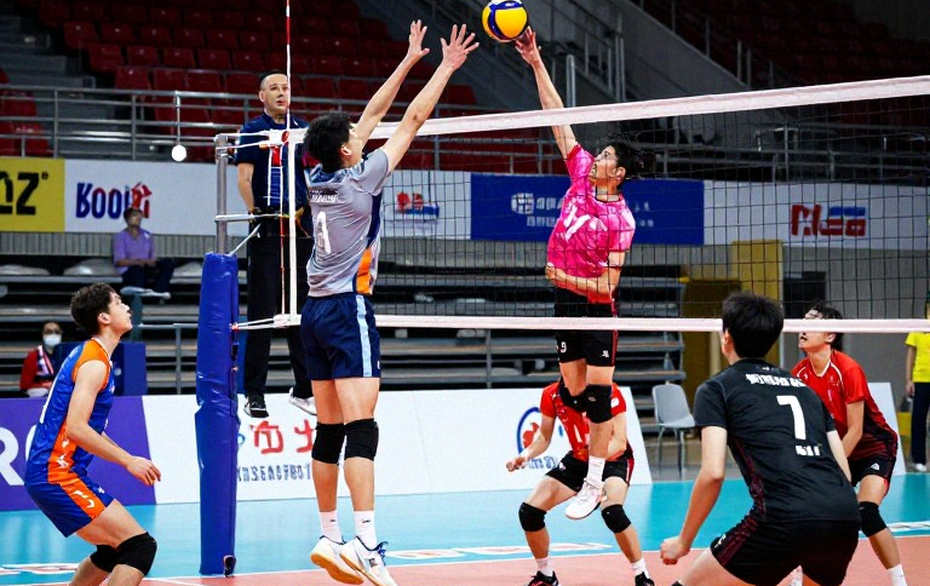
The block number should have been the most interesting part of the story today, because Pham Quynh Huong and Tran Thi Bich Thuy, one outside hitter and one middle blocker, both scored 17. That means Vietnam's middle attack worked for long stretches. For an Asian team with a wing-heavy scheme, a middle blocker scoring through quick middle attacks is a sign that the setter controlled the rhythm in favourable rotations.
When the middle runs, the opponent must spread its block. When the block spreads, the wings find gaps. When that structure is alive, Vietnam is an unpleasant opponent for anyone. The problem, once again, is that the structure did not survive to the twenty-fifth point.
Set three: the counter-evidence
Set three is the most important document of the match, because it refutes the laziest explanation of this defeat.
The sequence: Vietnam held set point at 24-23. The coaching staff used a video challenge on a claimed net touch by the opponent. The referee reviewed and ruled that the South Korean players did not touch the net. Point to South Korea. 24-24. For a great many teams, that is the mental end of the set. Vietnam still won it, 28-26.
A team that is genuinely mentally weak cannot win that set. A team that genuinely lacks nerve cannot absorb a ruling going against it at set point and still take the last two points.
So this defeat cannot be explained by the word fragile. It has to be explained by another word: consistent. This team can play at the required level under maximum pressure, for a short window. It cannot yet hold that level across a four-set match.
Those are two different diagnoses, and they lead to two different training regimes. A diagnosis of mental weakness leads to pep talks. A diagnosis of poor consistency leads to repeated pressure simulation, to set procedures for everything past the twentieth point, to pre-planned substitutions for stuck rotations. One is emotion. One is process.
I rewatched the third set many times looking for a small detail. The detail I found was not in the final rally. It was in the break between points after 24-24: on the technical bench, nobody stood up. The staff stayed seated, spoke briefly, and the players nodded. That is the mark of a group that has prepared for this situation.
If that is right, the paradox grows: if they had prepared for 24-24 in set three, why could they not prepare for 18-20 in sets one and two?
Set four, endurance and the 48-hour problem
Set four ended 18-25. The record notes declining physical foundation and rising errors in that set. This is the least controversial fact of the match, because it fits a separate ordering: psychological decline in sets one and two, physical decline in set four.
That order matters. If fitness were the root cause, the team would have collapsed in set three, not set four. If psychology were the only cause, the team could not have rallied in set three. The observed order suggests two different mechanisms running in parallel: one that handles scoring at the end of sets, and one that sustains intensity over time.
Set against the two-day gap between the September 18 match against South Korea and the September 20 quarterfinal, the picture sharpens. Two days is enough for a team that played four sets. It is not enough for a team that played four sets, showed physical decline in the last of them, and still has to travel and recover mentally. In that equation, a fresher opponent does not need to do anything special to gain an advantage.
And that opponent is defending champion China.
China in Asian women's volleyball represents a different kind of power from South Korea. They have height, a thick block, squad depth, and, most relevant here, strong and deliberate serving. If Vietnam's first contact broke under Kim Da In's targeted serving, the pressure in the quarterfinal will sit at another level, not because China plays differently, but because the number of dangerous servers they can rotate through is larger.
The run from the edit suite to the stands is longer than I thought, and the script lies somewhere in the middle. I once assumed I would write about a win or a loss. In the end I wrote about a stretch of forty-eight hours that nobody broadcasts.
Contrarian angle one: playing evenly flatters us
The popular framing after the match is that Vietnam played evenly with South Korea. That framing appeared in many headlines, and it contains a partial truth. Three of the four sets finished within five points. There was a set Vietnam won. There were moments when Vietnam led.
But that headline also hides a harder truth. South Korea controlled three sets. 21-25, 21-25 and 18-25 are three sets the Korean team held from start to finish, allowing the opponent to hang around in the middle phase. Vietnam's competitiveness was concentrated in two zones: the middle of sets and one exceptional third set. In the decisive zone beyond twenty points, the match belonged to the opponent.
This is not the writer's fault. It is the instinct of media: select the part of the story that makes readers feel better while remaining technically accurate. Playing evenly is a true statement at the level of match feel and a false statement at the level of match structure. A team playing evenly does not lose three sets to the same script.
There is another variant of the same problem: framing this match as bad luck or as spirit. Both framings ignore evidence already sitting in plain sight. A run of five to six consecutive points late in a set is not luck, because luck does not repeat in the same shape twice. It is an addressable hole.
Vietnamese fans deserve a more honest version, not because they need to be disappointed, but because they need to know precisely what is improving. A team that has come this far is mature enough to hear the truth about its own first contact.
Contrarian angle two: psychology is not the root, structure is
Almost every post-match analysis will use the word psychology to explain the points conceded at the end of sets. I think that diagnosis is convenient but incorrect, and its convenience is the problem.
Psychology in elite volleyball is rarely an independent variable. It is a dependent variable of structure. When an attacker knows her teammate will deliver a good pass and she will face a single blocker, she attacks with the confidence of someone standing inside a system. When she knows the ball will arrive from a broken first pass, that it will swing into a three-woman block, that her success probability is under twenty percent, she attacks with fear. That fear is not born of character. It is born of arithmetic.
In other words: losing the first contact does not merely remove one attacking option. It removes the attacker's confidence on the next ball as well. This is a spiral mechanism, and it explains the five-to-six-point runs perfectly.
If the correct diagnosis is structural, the training solution is not in a psychology meeting room. It sits in three very specific tasks. First, rebuild the reception formation to hide the weak passer inside the dangerous rotations. Second, build at least one escape attack from a broken ball, a shot the team can name and repeat in training. Third, pre-plan substitutions for stuck rotations, so that breaking a scoring run becomes a procedure rather than a stroke of luck.
The genuinely psychological part, the part I believe exists and is worth worrying about, lies somewhere else entirely: the capacity to endure a long match. Set three proves they can take pressure for one set. Whether they can take it for four remains unanswered.
Contrarian angle three: unverified numbers still teach the right lesson
I have to return to the sourcing problem, because it is the most honest part of this piece.
The match statistics are not attached to an official statistics provider. There is no perfect-pass rate. No attack efficiency net of errors and blocks. No block count by set. No average rally length. We have set scores, individual points for four players, and a qualitative description of lost first contacts and late-set conceding.
For someone who makes documentaries, this is a familiar situation. You have a shot and you know the shot is right, but you have no timecode, no name in the frame, no release form. You still use the shot, but you tell the audience you are unsure of its provenance.
What I believe about this match does not depend on a few point units. The pattern is too clear to be an artefact of statistical error: two sets with identical scores, one set won inside a long deuce, one set collapsing at the end, a scoring run in the twenty-point zone, and a failed video challenge at a decisive point. No data-entry error produces a pattern that consistent.
A sports documentary is not made to answer who won, but to ask why people love the game so much. Within that question, a number that is five percent off does not destroy the answer. Only silence destroys the answer.
Looking toward China: what can actually be carried forward
Facing the defending champion in a knockout match, after two days of rest, with a flaw now exposed, the realistic objective cannot be a semifinal ticket. The realistic objective is to carry something concrete home.
The South Korea match handed Vietnam three things worth carrying.
First, set three, as a blueprint. It was the only set in which Vietnam played correctly through the twenty-point zone, and they did it immediately after an adverse ruling. That is not a memory. It is a repeatable process, and repeatable processes can be trained.
Second, the spread of scoring. Four sources between 10 and 17 points is a healthy configuration. If China loads its block to shut down Thanh Thuy, Vietnam has evidence that it can survive without her leading the scoring.
Third, bench depth. A substitute coming on to score 10 points is the most important fact overlooked in every commentary I have read. In volleyball, a bench that produces points is what separates a team that can play four sets from a team that can play five sets in four days.
Conversely, one thing cannot be carried forward: the ability to handle heavy serving. That is not something fixable in forty-eight hours. It is something fixable in six months.
The most probable quarterfinal script is China serving into Vietnam's weakest reception zone from the very first set, building a run somewhere between the fifteenth and twentieth point, and forcing Vietnam into out-of-system volleyball for most of the match. That script is not pessimism. It is a direct description of what happened in the first two sets against South Korea, simply with a better serving team on the other side.
What could change the outcome is not a miracle but three specific coaching decisions: reorganise the reception formation before the match begins rather than after conceding three points, call the escape attack early, and use substitutions as a tool for breaking runs rather than as a last resort.
In place of a conclusion
One thought always lingers when I sit down after a defeat like this. Defeats are recorded in scores, while progress is recorded in things that never appear on the board: a first pass twenty percent cleaner than last year, a twenty-two-year-old willing to take a serve in the pressure zone, a well-timed substitution that breaks an opponent's five-point run.
Vietnam sits at the hardest stage of a rising volleyball nation: good enough to be analysed seriously, not yet strong enough for that analysis to be comfortable. The distance between being analysed and overcoming that analysis is the distance between the current position and an Asian medal.
First contact, set-end, forty-eight hours. Those three phrases add up to one quarterfinal against China.

And the question I am taking home tonight is not whether Vietnam can beat China. It is whether, after all these years, we have learned to listen to a defeat closely enough that the next one does not repeat in exactly the same shape.